Showing posts with label Illustration. Show all posts

Saturday, 20 October 2012

Re-imagining the land


One of the most notable images of early Albany is the Panoramic View of King George's Sound, Part of the Colony of Swan River, a well known hand coloured etching and aquatint from 1834. It was created from sketches by Lieutenant Robert Dale and etched by Robert Havell. Dale was stationed at King George's Sound in early 1832, six years after the English commenced a colony there. This section of the view shows Lake Seppings and Oyster Harbour in the distance. On the left of the drawing is the cleared and neatly plowed square of land on the government's Strawberry Hill farm.

The view today from a similar vantage point

The foreground on the top of Mt Clarence is now very overgrown - that shrubbery in the foreground is a good three to four metres high. On the day I took this photograph there was a bronzewing pigeon scratching in the undergrowth like a tiny chook - something I've never noticed them doing before.

In the panorama by Dale/Havell the foreground has a number of small herbaceous plants indicative of fairly open ground, with bigger shrubbery further down the hill. However all the land on the lower plains near the lakes is grassland interspersed with clumps of trees. For the Aborigines it would have provided good feed for kangaroos and made hunting that much easier. The grasslands were managed with regular burning to keep the bush at bay.  Edge habitats are usually regarded as being more species rich than each of the individual habitats, so that makes good sense too.

It is strange how the present day golf course imitates the original landscape as managed by the Aborigines before colonisation. There must be something about a parkland cleared landscape that is pleasing to our psyche.  For the golfers I suppose it is more of a challenge having the fairways edged by a good bit of rough.


I don't know if the tall Kingias, shown in the centre of the drawing, would have actually been there or were placed in the drawing because they represented the 'exotic'.

I can say there are smaller Kingia's still growing near the top of the hill, but they are crowded out by the thick and tall vegetation that has grown up around them. It must be quite a while since a fire went through; they have long skirts hanging down from the top.

Believe it or not there is a Kingia growing in this tangle of shrubbery - catching the sunlight in the middle ground.
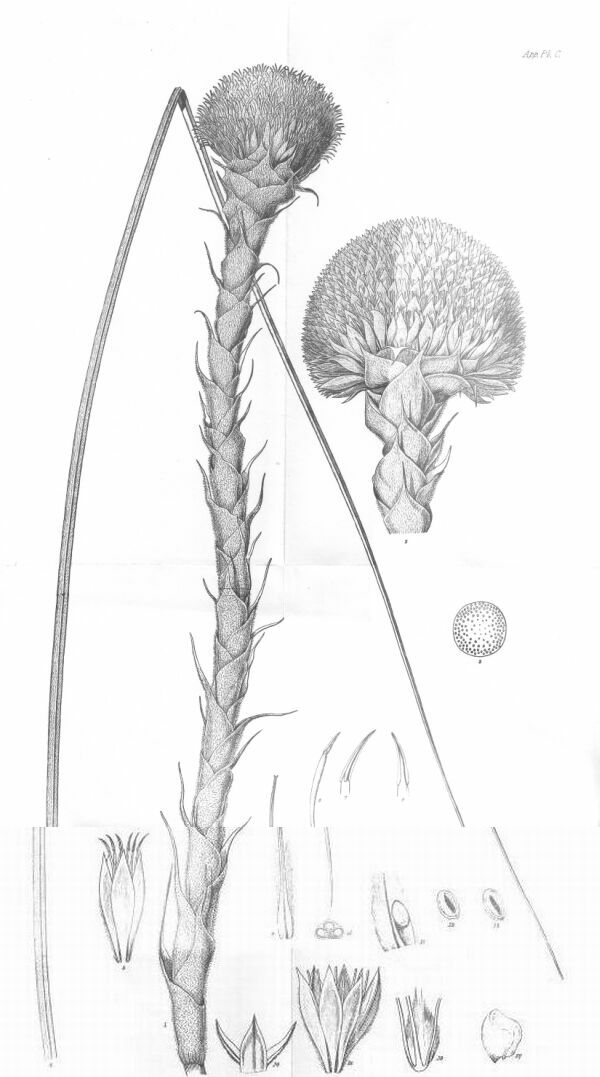


Here is a botanical illustration of Kingia australis, originally published in 1827 as part of Captain Phillip King's book on his travels mapping the coasts of Australia from 1818 to 1822. The engraving is by J. Curtis.


Today, there are a few big old trees growing on the hill, all very spreadeagled, unlike the younger trees that are growing closely together and straight up. In their youth they must have had a lot less competition for space and light to enable them to grow wide rather than up. Perhaps a bit of being sculpted by the wind too - something which isn't a problem today, the bush is so dense.


I find it very interesting, looking and comparing the past and the present, and trying to image what it was really like back then. In some ways it is like seeing the landscape, and ways of managing it, with totally new eyes. It  certainly raises a lot of questions for me about how one 'chooses' just what is the 'right' ecological landscape.


Link to National Library of Australia
Link to Gutenberg Phillip King's book.

Monday, 1 October 2012

Dancing, drums and drills

Matthew Flinders surveyed the shores of Australia in the ship the Investigator, and was anchored in King George's Sound in December 1801 through to early January1802 before any British occupation of the area. He published a journal of his travels A Voyage to Terra Australis in two volumes which I found as an ebook from Gutenberg. It is a boon being able to access books like this so easily. I am actually investigating representations of the environment and vegetation, but occasionally other things jump out at me.

Anyway, I was fascinated by his account of  Wednesday 30 December 1801:

On the 30th, our wooding and watering of the ship were completed, the rigging was refitted, the sails repaired and bent, and the ship unmoored. Our friends the natives continued to visit us; and the old man with several others being at the tents this morning, I ordered the party of marines on shore to be exercised in their presence. 


The red coats and white crossed belts were greatly admired, having some resemblance to their own manner of ornamenting themselves; and the drum, but particularly the fife, excited their astonishment; but when they saw these beautiful red-and-white men, with their bright muskets, drawn up in a line, they absolutely screamed with delight; nor were their wild gestures and vociferation to be silenced but by commencing the exercise, to which they paid most earnest and silent attention. Several of them moved their hands involuntarily, according to the motions; and the old man placed himself at the end of the rank, with a short staff in his hand, which he shouldered presented, grounded as did the marines their muskets.

Drawing by an Aboriginal of the Kingston Tribe S.A.
from John Fairfax Conigrave, Adelaide, 1886.

Charles Darwin was in King George Sound in February 1836 and did not enjoy his time there at all; the summer heat, coarse vegetation and sandy ground, was probably too much for him. In his book The Voyage of the 'Beagle' he described a corroboree he witnessed while there. Here is an edited version:

A large tribe of natives, called the White Cockatoo men, happened to pay the settlement a visit while we were there. These men, as well as those of the tribe belonging to King George's Sound ... were persuaded to hold a "corrobery," or great dancing party. As soon as it grew dark, small fires were lighted, and the men commenced their toilet, which consisted in painting themselves white in spots and lines. As soon as all was ready, large fires were kept blazing, round which the women and children were collected as spectators; the Cockatoo and King George's men formed two distinct parties and generally danced in answer to each other. 

Engraving by J. Neill from Edward John Eyre, 1845

The dancing consisted in their running either sideways or in Indian file into an open space, and stamping the ground with great force as they marched together. Their heavy footsteps were accompanied by a kind of grunt, by beating their clubs and spears together ... In another dance, one man imitated the movements of a kangaroo grazing in the woods, whilst a second crawled up, and pretended to spear him. When both tribes mingled in the dance, the ground trembled with the heaviness of their steps, and the air resounded with their wild cries. Every one appeared in high spirits ... and so perfectly at their ease. After the dancing was over, the whole party formed a great circle on the ground, and the boiled rice and sugar was distributed, to the delight of all.

The visual parallels between the marine drills and corroborees were not lost on either Flinders or the Aboriginal people. Unfortunately the marine uniforms would soon come to represent negative attributes like  power, authority, retribution and an alien system of law.


Untitled tryptic by Gordon Syron, National Museum of Australia, Canberra

The last word on redcoats doing drill must go to Gordon Syron who plays with the way history has traditionally been visualised. He is a political artist who identifies as Aboriginal. He uses 'satire and raw imagery to send a message that Australian History has left out the Aboriginal people and their stories'. In his art he often 'turns around the picture' by doing things like portraying Aboriginal people in redcoats and black boots and reversing other historical Aboriginal and white roles, forcing the viewer to reconsider history.

Link to Syron's website here.  

All images sourced from the internet.

Wednesday, 23 May 2012

Odyssey to suburbia

On the weekend we did another of our -mad- dashes to Perth, this time to hear Shaun Tan talk about his work and to view the animation of The Lost Thing. This was part of the opening event for his exhibition Suburban Odyssey showing at the Fremantle Arts Centre till 15 July 2012.

Part of the madness was due to a carload of five puppies - six weeks old now - and their mum, Miske. We left at 9am and the first half hour was mayhem, with five crying puppies wanting to be anywhere but in the car - despite the rib bones I'd given them as a distraction. Mark very wisely wore his earplugs while I sat in the back with them till they settled. From Mt Barker onwards things improved, one puppy settled at my feet on the floor of the passenger seat, the rest stayed in the back sleeping and occasionally complaining. Reaching suburbia and running late we quickly organised a car swap. My parents bravely took our car with puppies and we took their car arriving in Fremantle in good time for the talk. Unfortunately because of the huge crowd attending, the talk was moved from the Arts Centre to Notre Dame University so we didn't get to see his exhibition this time around. The day had been quite long enough ... We will see the exhibition next month I hope.


Shaun started by showing The Lost Thing, the trailer for it is above. Its a great little tale about amongst other things seeing the unusual and magic in your everyday life. Travelling up to Perth and into the city one really notices the busy-ness of everyone filling the city malls - endlessly dressed in business black - and the cars zooming along on an endless loop. Caught in the treadmill of our own making. People get so engrossed in what they are doing they miss the little things (or important things) - like the lost thing - until it trips them up. The story is peopled with bored unseeing office workers in a nightmarish bureaucracy but secret places to be found if you look. How many times do we see something strange but not investigate or wonder and simply forget about it?

'A moment of nostalgia on the way home from work'
from the end of The Lost Thing 

Some of the background imagery comes from Shaun's observations of scenes of suburbia. They are beautifully rendered, potent with feeling, angular building set against sketchy and mysterious greenery, peopled by crows, the streets one sees in the early hours of the morning. Empty streets that don't quite feel empty. The exhibition is largely about these suburban scenes by Tan. He describes his memories of growing up in Perth as 'long, hot afternoons, wide and empty suburban streets, the drawl of crows, ocean air, unfiltered light ... being somewhere and nowhere at the same time. Sound familiar? Especially the somewhere and nowhere - Perth is so far from anywhere else - you could almost be at the end of the world. And the suburban sprawl ...


Night Train, Mt Lawley


'Fighting crows'

Tan explained how he loved to play with the absurd, the what if of imagination - that along with close observation of that which was around him. He said he loves to play with that - images like the buffalo in the vacant grassy block, directing the little girl - arise from that. Too often we do forget to play with ideas and allow the absurd speak its mind and lead us to who knows where. It reminds me of the vacant blocks we used to play in as kids when visiting our grandparents - we'd imagine all sorts of things in there - apart from    weird finds of bits and pieces and spooky dilapidated buildings. 

Image from Tales from Outer Suburbia


Another what if - the giant groper in The Red Tree

He describes his work as a combination of reality, fantasy, childish play and adult reflection. This is evident in his illustrated books. They are often thought of as being for children because they are illustrated with little text. However the subject matter often gives pause for serious reflection, poses philosophical questions, plays games and reveals hidden references on closer scrutiny.

Tan spoke about The Rabbits which John Marsden wrote and he illustrated. Its an allegorical tale about colonisation, a subject which Tan says he finds fascinating from a political as well as 'an event of utter strangeness where two very different worlds collide'. The story has echoes throughout the world - the might of power and ignorance playing out with degrees of environmental and cultural destruction. Apparently this book was banned in some Queensland schools - it must have been a bit too close to the bone. I think the book is fantastic (in both senses of the word) even though the end is depressing/disturbing/too true.


'Houses' from The Rabbits

Just to finish - I so love this image from Tales from Outer Suburbia. Two brothers set out to find out if the road just ends where the street directory stops - like a missing page. This is what they find. Paved to the edge of the world. Its beautiful, sitting on the edge of the world ... the birds can fly out past the edge ... and the water draining to the ineffable somewhere else.


'How great it must have been long ago, when the world was still unknown' from Tales from Outer Suburbia


Link to Shaun Tan's website here.