Showing posts with label out walking. Show all posts

Thursday, 7 November 2013

Beach surprise

After an absence of several weeks I finally got to the beach today. Miske had been in season which meant we had been confined to walking in 'safe' locations: down to the dam and back or into the bush next door. Definitely not to the dog beach. Blake, the puppy we kept, had been taken to the beach a few times by friends when they took their dogs down to the beach, so he had at least had a bit of fun. Blake is now as big as his mum, much to her chagrin. She wants to be boss and he wants to be annoying. Now Blake just woofs at her to let her know he isn't happy about something. I have seen her give up a bone to him after one woof. Not a good precedent if she wants to stay boss.


The tide was way out exposing thin green slivers of water weed laying flat on the limestone rocks, the weeds occasionally raised up as an incoming wave lifted and swirled around and over then raced towards my feet tracing the moving edges of the water. Sooty oyster catchers with their distinctive red beaks and eyes took advantage of the low tide, and picked and probed a smorgasbord fresh from the rocks.


While I was photographing the ocean an immature Pacific Gull lazily drifted into my picture frame. 


It floated along the jagged limestone edge just in front of us before it flapped up and off further down the beach before commencing the lazy drift again. 


The last thing I expected to see down the beach this morning was a small flock of white tailed black cockatoos. They were feeding on the seeds of the wild geranium growing only metres from the sandy beach. The birds were half hidden on the ground, becoming visible as they flapped up and drifted a few metres along with the breeze, then dropped down to feed once more.


Look carefully there are five cockies in the image above.


Here they are much easier to pick out. They are probably Baudin's Cockatoo as they breed in karri country as opposed to Carnaby's Cockatoo which breed mainly in the wheatbelt. Their different bill shapes are rather difficult to determine from a distance. Baudin's has a long narrow upper bill and Carnaby's has a short thick upper bill. Their calls are different too, but these fellows were too busy eating to be calling.


Monday, 27 May 2013

Languid

The afternoon warm was warm, the air still, lazy. The distant blue waters of the inlet mirrored the sky, occasional soft breezes skirmished the surface. A whipper snipper buzzed down the not so lazy kikuyu that sprang up in the late autumn warmth. A kookaburra claimed his territory.  High in a karri tree a ventriloquist magpie sang the songs of magpies, wattle birds and kookaburras. I wondered if the kookaburra I heard was really the ventriloquist. I don't know.

Then I spied a magpie hanging upside down, its claws clenched onto the tips of a karri branch, swinging wildly. It pecked at a cluster of leaves held together with webs - the hidey hole for some tasty morsels. Swinging. Leaves fluttered to the ground.  With the parcel secure in its beak the maggie arighted itself on a nearby branch to feast. Parcel clutched in the claws of one foot, the other clung to the branch. Peck, peck: it feasted then dropped the leftovers. All the while the ventriloquist sang.

Autumn days like that are just beautiful. Relax, soak up the sun. Watch the puppies gorge themselves on milk, then sleep and get fat. They've certainly got their priorities worked out. I sat in the sun and sketched blue wrens and fire tail finches as they flitted and fed around me.


This was the moon that night - a couple of nights ago. I've been trying to capture the moonrise as it hangs suspended in the last rays of the sunlight but I always seem to miss it. By the time I see the moon through the trees it is way up in the sky - just because of the lie of the land around here.


I remember a few years ago we were travelling up north near the Gascoyne River in the middle of winter. The rising full moon and setting sun both hung suspended above the horizon for what seemed like ages as the sky changed colour from gold and green to peach and pink then indigo that slowly arced across the sky. It was so beautiful.


Wednesday, 17 April 2013

Beaufort Inlet

We arrived at Millers Point in the afternoon warmth, as small black coots swam low in the water and left a wake of tiny sparkling suns.

Coots feeding

Millers Point juts out into the Beaufort Inlet on the Pallinup River and the campsites are scattered among straight trunked eucalypts and twisty paperbarks.


From our spot we could see and hear the distant ocean which pounded on the bar to the south east and look around to the north west where the broad expanse of water disappeared behind hazy blue hills.


Looking inland

It is quite obviously a haven for fisher folk. The other campers took off early in the morning and returned in their dinghies late in the afternoon, leaving the point deserted apart from us and a couple from the eastern states.


The quiet thrum of generators that preserved their catch was the only human made sound to be heard during the day. Late in the afternoon the pelicans flew in waiting for the scraps from the returning fisher folk. The pelicans gave an occasional grunt; perhaps a 'hurry up and feed us' or a 'it's all mine not yours'. I don't know.


In amongst the rocks I found piles of silvery discs, the relics of successful fishing ventures.
The sandy beaches were covered in webbed footprints.


An old sign whose original intent has long since been lost


We walked to the lookout through a beautiful glade of eucalypts with trunks of ochres and greys.


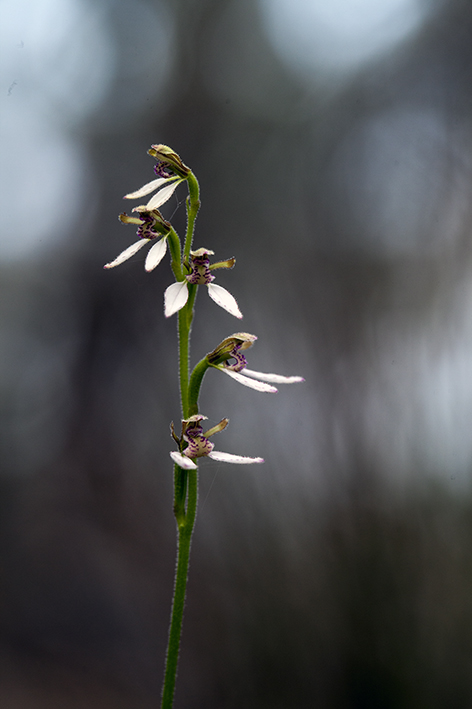
 In the thick mulch below grew autumn flowering bunny orchids.


And on the fallen branches grew these lovely lichens.


The view from the top past flowering Hakea laurina towards the bar and ocean.


According to South Coast Rivercare the Pallinup River rises in The Yilgarn Plateau south of Katanning with some salt lakes draining into the catchment in wet years. All the river is saline to some degree. The salinity has increased since clearing in the catchment region especially since the 1950's. Melaleuca cuticularis (saltwater paperbark) and Eucalyptus occidentalis (yate), are found growing here as both do well in saline conditions.

Thursday, 7 March 2013

Walking in Harewood

When we first walked this trail eight years ago it was a one hundred year forest. 


This hillside was part of a much larger logging holding that was taken up by the Millar brothers in 1895. The Millars opened their first mill in Denmark in 1893 and by 1905 all three of their mills were closed. By then the loggers had clear-felled all the ancient karri trees, and left a bare and ravaged landscape.

Timber cutters working on karri tree (Denmark Historical Society)

The demand for timber had been so high that the millers worked night shifts as well. Can you imagine working on a cold wet winters night with sharp steel blades, noisy machinery and massive timbers - by the light of kerosene lamps? 

level7mill.jpg - 27Kb
Old timber mill  (Denmark Historical Society)

It is quite different now. The steepest parts were abandoned and the bush re-covered the hillsides. Over time the gentler muddy red curves were coaxed into grassy green mounds by new settlers. Pretty but challenging. Today the patchwork of forest, pasture and vines is as varied as the people that now live there.

Last weekend we walked in this forest as summer gave way to autumn. As we arrived a deep indigo cloud dumped its load and a couple with a young child sheltered in their car. 

The rain had coloured up the mosses and lichens and frogs sang in their freshly moistened skins.


A fantail peeped close by as it flicked and fanned its tail


Old bark turned back


Shadows played


Strands of discarded summer trailed high overhead.


Cream karri trunks ready for the new season


The allocasuarina's deep corky bark flaunted the past, hid the present

  
Red winged wrens danced a duet  through the undergrowth


Tannin dark water rippled over black slippery rocks


In a pile of fallen bark at the base of a one hundred and eight year old tree, the child told us he was making a special spot for the forest fairies.


Did you have secret fairy spaces in your childhood? I did. I remember a special place at the top of our bush block in Parkerville. It was nestled in an ancient burnt out tree stump. The floor was mossy green sheltered by the jagged charcoal edges of the stump. In the hollowed middle green snail orchids grew as high as a fairy's waist. Outside in spring bright yellow cowslip orchids bloomed. In grade one we had a spot in the bush above the school. This place was encircled by grass trees and it too had orchids; from memory they were tiny pink fairy orchids.

I nearly missed the beauty of the reflections in the creek. It was only when I sat down on the rocks in the creek - slowed down to watch the wrens - that I saw them. Special places - it doesn't take much really - slowing down, seeing, imagining.


Tuesday, 8 January 2013

Savouring summer

For me, summer is soporific. The heat and humidity lull me into a space of relaxation despite wanting to do a heap of things. Outside in the middle of the day the sun burns within minutes. Even if it is hazy or cloudy. We always have UV index figures in the extreme category; today it is 14.  I blame it on the ozone hole above Antarctica. According to NASA it is not expected to return to its pre 1980's size till about 2060.

However there was nothing like nearly stepping on a tiger snake while out walking with Miske to get the heart racing. The snake was very dark black, very very fat and ended with a short narrow tail. She disappeared quickly off the trail, flattening her body behind her head as she went, to look bigger and scarier. That wasn't necessary - trust me, I got a heck of a shock she was so close. Bear in mind I was out walking bare footed ... and Miske was happily sniffing and investigating scents and sounds just ahead of me.

Checking with Dad, he suspected the snake was gravid. She was so fat there could have been quite a few baby snakes packed inside her. Female tiger snakes can produce litters of up to forty live young. Tiger snakes are one of the group of  viviparous snakes (those that give birth to live young), mostly found in the cooler regions of Australia. Their venom is dangerous, containing chemicals that cause presynaptic and post synaptic paralysis, coagulopathy (reduced ability to clot blood) and muscle destruction. Sounds like they have all the bases covered.  However, people usually only get bitten if they try to interfere with the snake - or accidentally tread on one.

Only a few paces further along the trail I heard another slithery rustle slipping away from the trail. Miske heard it too and she wanted to investigate - but I said no. On the way back, she again wanted to check out the slithery rustle bushes. No way! I think I will avoid that part of the trail for a while - the mind boggles at the thought of dodging dozens of diminutive tigers, let alone the adults!

It was only a couple of days ago that I was surprised by another tiger snake coiled in a figure of eight beside a track down by the creek. It quickly slipped off into the bush when it heard me. Again Miske was ahead and oblivious to it's presence. The day before that, Mark was surprised by a dugite that was surprised by Mark, right beside our carport. The large brown snake quickly slithered up the bank, and disappeared into the ground cover there, but for a moment they were almost eyeball to eyeball. Fright to flight.

Summer is also the season for making jams and chutneys. While waiting for the first apricots to ripen I was reminded of my friend's apricot orchard. She always said in the week before Christmas she heard the 'plop, plop, plop' of ripe apricots falling to the ground. Down here it is the week after the new year that the apricots ripen and fall to the ground, but without the "plop, plop, plop' as here they fall onto soft green grass, not the dry gravelly ground of the Perth hills.

It is now a week into the new year and I am picking and eating apricots. Yesterday I made my first batch of apricot jam. I love the fragrance of cooking apricots and the sight of jars full of translucent apricotness. Today I made apricot chutney. I'll leave the snakes to savour the summer sun, while I savour the summer fruits. And maybe, just maybe, put my shoes on for my walks with Miske.