Showing posts with label a backward glance. Show all posts

Wednesday, 8 October 2014

But what about the Orchids?

Out at Tenterden there were swathes of them. It was quite an Unexpected Delight. In planning to go out there I hadn't really thought about anything more than Water in the Wetlands and going back to the Scar Tree.


Scar Tree

Walking through clumps of white spider orchids and spying the rich  pink and purple hues of enamel orchids reminded me of my childhood. We used to go out orchid hunting in the bush, particularly me and my youngest brother Shane. We were infatuated with native orchids for some years. (I still grow orchids, mainly eastern state hybrid epiphytes. This year's flowering has been brilliant).

White Spider orchids

 I remember squealing with excitement when I first found a Queen of Sheba Orchid in Kalamunda.  This uncommon orchid has rich flowers of orange and pink with purple spots, and it has a remarkable cork screw spiral leaf. That orchid was probably the beginning of my fascination with orchids. Sadly, the area in which it grew is now covered in housing.

Purple Enamel Orchid

Our favourite orchid spot had a huge number of species growing there, even the unusual flying duck and hammer orchids. This patch of bush was in a winter wet drainage line behind the high school in Mount Helena. It was magic.

Cowslip Orchid

We'd ride our bikes from Parkerville up there in the orchid season, spend hours hunting for flowers or tell tale leaves and only leave when pangs of hunger sent us treadling home. Luckily the home run was slight down hill, it could be quite warm in the middle of the day in October. To our great dismay, our orchid patch was soon to be used as a dumping site. Great holes were scraped through the ground and rubbish dumped on top of our beautiful orchids. They were destroyed. Those were the days when damp patches of ground were seen as useless and to be filled in. We were too young to know how to protest.


Purple Pansy Orchid

Common Dragon Orchid

Common Dragon Orchid

Bee Orchid

Bee Orchid
There are many species and sub-species of white spider orchids. I hardly dare to put a name to these ones. The top one with the labellum dipped in magenta could well be a hybrid, as I couldn't find it in my orchid book. Most of these orchids were found growing in the swales between the lakes. The Dragon Orchids were growing on higher and dryer lateritic ground. 

Spider Orchid

Common Spider orchid - Caladenia varians ssp

That is a mosquito on the orchid below, and yes, they were very intent on attacking me. That was the small price I paid for these photographs.

White Spider Orchid - Caladenia longicaudata ssp
It was a real buzz to see these orchids thriving here on this farm. All thanks to Alan and his family for a combination of historically low impact farming and concerted efforts more recently to save this part of the landscape. 

Sunday, 2 February 2014

all hover and hammer

And I was alive in the blizzard of the blossoming pear,

Myself I stood in the storm of the bird-cherry tree.

It was all leaf-life and star-shower, unerring, self shattering power,

And it was all aimed at me.

What is this dire delight flowering fleeing always earth?

What is being? What is truth?

Blossoms rupture and rapture the air,

All  hover and hammer,

Time intensified and time intolerable, sweetness raveling rot.

It is now. It is not.


Written on May 4 1937, from Stolen Air, a book of poems by the Russian, Mandelstam, selected and translated by Christian Wiman, 2012. This was one of the last poems written by Mandelstam.
Through his poetry  and essays Mandelstam was increasingly critical of the Stalin government. He wrote and conducted private readings of his poem 'Stalin Epigram' during 1933.  This led to his arrest in 1934 by Stalin's henchmen. He was sent into internal exile with his wife.
After a suicide attempt by Mandelstam his exile was modified to ban only the big cities so they settled in Voronezh. By 1937 his work was being discredited again and he was arrested in May 1938. This time he was sentenced to five years in a correction camp and sent to a camp near Vladivostok. He died on December 27 1938 and was buried in an unmarked grave.
In 1956 he was partially exonerated, and in 1987 he was fully exonerated of all charges against him by the Gorbachev government. 

(The birds above were clamorous, keenly feasting on the nectar rich flowers.) 

Thursday, 30 January 2014

Early dance stories


I remember as a young girl, bending and stretching, in black leotard and mended tights, the running stitches looking like haphazard little black caterpillars. With my awkward arms and gangly legs, I was never going to be a graceful black swan. We filled the small hall, learning the rudiments of ballet and tap dance. I can still do the 'shuffle hop step, da da da da' though goodness knows what else went with it. At one end of year show, The Wizard of Oz, I was a munchkin in an icky pale green outfit with fabric daisies stuck on it. What an awful delight; a bunch of little girls in daisy suits. Perhaps we sang a munchkin song? I was more excited that Toto was played by a real dog. Small and white and fluffy. And it didn't pee on the stage.


This gives you an idea of our costumes. The photo was taken by Dad in 1966. I am in the second row, central in a red 'highland dance' costume. My sister is in the front row in a pale bluey green costume with the frilly hat. Delightful .... hmmmm.

Fast forward a few years and we were in Papua New Guinea. Dance there meant being part of colourful sing sings. All the villagers from miles around were involved. The costumes were magnificent; extravagant headdresses, arm and leg bands, grass skirts, painted tapa cloths, hibiscus flowers and colourful feathers. A world away from the dance hall in Mundaring. The dancers moved to a simple chant and drums while nearby a huge feast was prepared. We learnt the simple steps that made our grass skirts swing backwards and forwards to the beat.


This photo was taken at a Sing Sing at Kokoda in September 1970. 

And the Papuans could sing. Singing from the 'cradle', or in their case the bilum, their voices were clear, confident and harmonious. It was a revelation and I loved that freedom of expression so apparent there and in boarding school. At boarding school we sang all the time. On the bus too and from school, everyday in the chapel, at choir practice and we just sang for the pure pleasure of it. I had the shock of my life when four years later we came back to WA and people just didn't break into song because they felt like it.


It was at boarding school some Port Moresby girls taught me a more complicated rolling of the feet dance movement. It was rather like tracing a circle on the ground with each foot. Your bent knees and hips followed your feet, swaying in circles. Add in some pretty arm movements, a skirt and some frangipani leis and you had a Papuan hula. But we were in an arid gold mining town, surrounded by mulloch heaps, chinky apples and a town nearby whose claim to fame was a gallows in the main street (morbidly fascinating to teenagers). So no frangipanis, just a few hardy hibiscus to put in our hair.


Sharon on the left was one of the girls who taught me the Papuan hula moves. It was 1972 let it all hang out peace man. Just for the record the red spot behind Sharon is an hibiscus flower.

Later on it was bush dances with the Mucky Duck Bush Band on Saturday nights. On the weekends when we weren't dancing we were in the bush camping and caving. Those were the days of cheap fuel. I think it cost about ten dollars for a weekend down south. Outside of work we lived for being in the bush, getting grotty, then swimming in a river or the ocean or trogging through an underground stream - or just staying grotty.


It was a big step from my early experiences to being part of the Songlines project last year, a community performance of Joey Williams' songlines from the Stirlings to Denmark.  As part of our rehearsal process we had a morning down by the river swimming and dancing. We learnt about Joey's family stories that we were performing, a variety of types of fire, sparks, and smoke. Performing on stage was initially confronting but the nerves disappeared when concentrating on the dance. I am still not fluid but happy in being brave enough to have a go and I have learnt  about the arts of concentration and transformation of ideas into movement. But the best part is a shared experience with other members of the community and having fun in the process.


Monday, 26 August 2013

Prospector and Dreamer

We found a beautiful campsite just out of Mount Magnet, beside a thicket of cool and shady pepper trees, in the ghost town of Lennonville.

We camped on the other side of these pepper trees

It seems William Louis Smith had loved it too. Under the trees in the dense shade was a plaque remembering him: 1910 - 1996, loved father and grandfather, prospector and dreamer. The camp has a freestanding fireplace and hearth; the rectangle in the picture. There are wires strung up on which to hang shadecloth, a comfy chair and tables made from heavy machinery parts.

Camp for dreaming

Above in the trees was an occupied bird of prey nest; we heard the young calling to the parents. I think they were whistling kites. My bird book describes them as scruffy gingery birds. At sunrise three birds sunned themselves in first warming rays. (And a happy camper in William Louis Smith's camp could do the same.) 


Whistling kites 

Lennonville was established in 1898 when gold was found there. In it's heyday it boasted five pubs, and a railway line servicing the population of up to 3,000 people. The Welcome Gold Mine, just two miles north of Lennonville, produced nearly 5,000 ounces of gold.  

Mining ruins

One strike there was particularly rich producing up to seven ounces of gold to the ton of ore. The story goes that a favoured Sunday outing for people was to go to the mine to marvel at the dazzling display of gold in the richest veins. I can just imagine ladies in long skirts and gentlemen in dapper duds ooing and aahing in the heat and dust. 

The only thing left standing in Lennonville


From 1905 the town and gold dwindled in tandem with each other. A fire in 1909 destroyed the main part of town hastening it's decline into a ghost town. 


Lennonville railway platform

As to William Louis Smith, we know nothing more. 
But it surely helps to be a dreamer chasing gold out here; it is a tough environment. 
Then again, perhaps all prospectors are dreamers?


Twisting vine

Monday, 13 May 2013

Woolly banksia


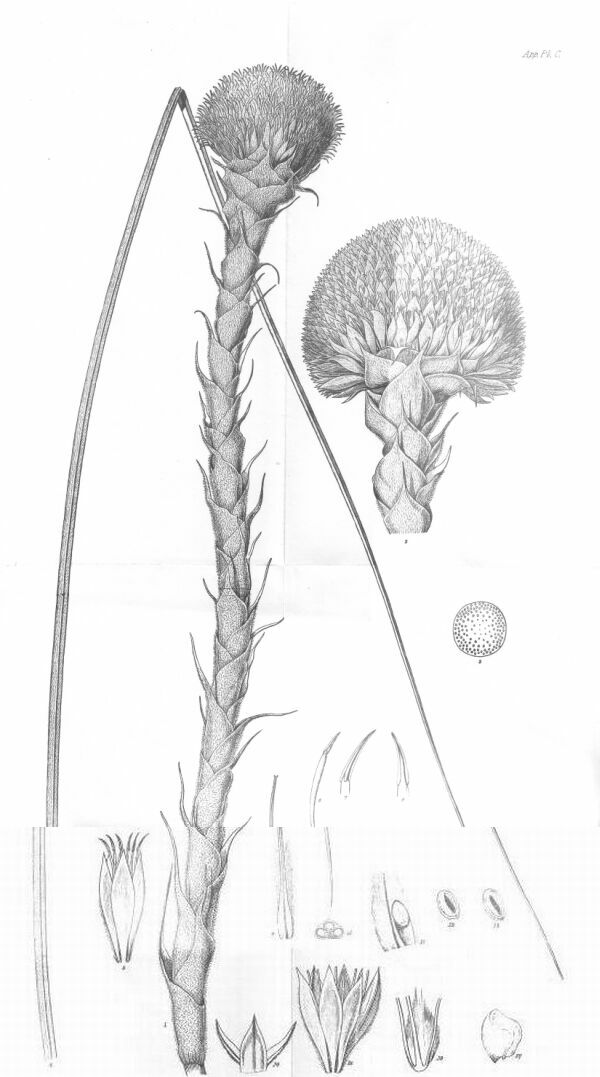
This lovely Banksia baueri is flowering in our garden at the moment. The flower heads are large - a good twelve centimetres in diameter and very soft and woolly. Unlike most banksias they are pollinated by little furry marsupials like honey possums and pygmy possums. So far I haven't seen any mature seed pods on the old flowers so I guess we haven't hit the jackpot in attracting them to our garden yet, but I live in hope.

Banksia coccinea, plate 3 in
 Illustrationes Florae novae Hollandiae
Ferdinand Bauer

Banksia baueri was named by botanist Robert Brown after the brothers Ferdinand and Francis Bauer. These brothers were fantastic natural history illustrators. Franz was botanical artist attached to Kew Gardens in England from 1790 to 1840. Ferdinand was employed as botanical draughtsman under the direction of Robert Brown as chief botanist aboard the Investigator, captained by Matthew Flinders. The English  expedition of discovery left Portsmouth in 1801, circumnavigated Australia, and was forced to stop at Port Jackson where the Investigator was condemned as unseaworthy.


Johnsonia lupulia, plate 1 in
Illustrationes Florae novae Hollandiae
Ferdinand Bauer


Brown and Bauer finally returned to England in the repaired Investigator in 1805. In the intervening time Bauer explored the Sydney region and spent eight months on Norfolk Island. Over the four year period Ferdinand made over 2000 drawings, mainly Australian plants. After their return Ferdinand  Bauer spent years working on three hundred watercolours from his Australian sketches, most of which are held in London, and a series of hand coloured etchings for his Illustrationes Florae novae Hollandiae which was published in 1813.


Brunonia australis, plate 10 in
Illustrationes Florae novae Hollandiae
Ferdinand Bauer

The first two illustrations by Bauer are of plants that grow in the Albany region. The third illustration is of one of my favourite inland plants. It is a magnificent sky blue which always looks startling when seen against the rich ochre red soil in which it commonly grows.


Ferdinand Bauer images from the National Gallery of Australia.


Saturday, 6 April 2013

Blossom and rain?

As kids we were told by Dad that a heavy blossoming from the eucalypts in summer would be followed by heavy rains in winter. This summer the blossoming has been exceptional. I don't know if there is truth behind the saying but it will be interesting to see if we have a wet winter. The theory goes that the trees know there is to be a wet winter. Therefore they produce lots of flowers so they can set plenty of seeds ready for the forthcoming good growing season thanks to the all the rain. When I asked Dad who told him about this he said it was the local Noongars who lived in Perth and had family connections to the south west.

The jarrah trees were loaded with blossom in November. Thinking back to my childhood, in the days before our rainfall dropped off so dramatically in the 1970's, there were good flowering years but  I can't remember seeing trees quite so snowy white. For quite some years now the jarrah blossom has been sporadic and unexceptional. I thought the trees were too stressed to flower well - so many years of below average rainfall and hot hot summers - but somehow they managed to put on an amazing show this season.


Jarrah blossom - Eucalyptus marginata


Jarrah 


It seemed every jarrah tree was covered in creamy stamens including the ones you didn't know about. The nearby bush sprouted giant jarrah trees that I never realised were growing there - in the previous eight years that we have lived here they had never flowered.
 From a distance the trees glowed in the sunlight, like giant random candles.

Marri trees in bloom glowing in sunlight

Following that, in February the marri put on an amazing show, especially up towards Perth. Again the trees were dripping with blossom and nectar and the air was heavy with the rich sweet scent of it. 
There is nothing quite like it.
 Down here the blossoming was not so heavy in February but the marri is in the throws of a second heavier flowering now. Even some of the red flowering gums are having another crack at it.


Marri blossom - Eucalyptus calophylla
or Corymbia calophylla

Marri 

So I am waiting to see what winter brings. According to the old local knowledge it should be a beauty.
 Time will tell.


Tuesday, 20 November 2012

Walking with Archibald Menzies


In light of the recent eclipse of the sun which was visible over in Queensland, I was amazed when reading Archibald Menzies' diary of his arrival in King George Sound: 'On the morning of the 28th of Sep'r [1791] the sun rose eclipsed which was distinctly visible to us'. Menzies was the botanist (and surgeon) on board the Discovery, commanded by Captain George Vancouver on the 1791-1795 voyage from England to explore the Pacific region and the northwest coast of North America, via Australia and New Zealand. They spent some days exploring and collecting in this area from 27 September to 13 October 1791.

This amazing time lapse photograph of the eclipse by Ben Cooper

He describes a romantic landscape, after climbing a 'small prominence from which we had a full view of the Basin & a considerable tract of country beyond it ... was pleasantly diversified with groves of trees hills and valleys forming a rich & picturesque prospect boldly drawn by nature's manly pencil, but the inland country was one continuous forest of trees' . I was surprised that nature had a manly pencil - I thought nature was aligned to the feminine - or perhaps it was, but it was men who observed, drew, used her?


John Sykes, 1791
A Hut of King George III Sound 
on the South-west Coast of New Holland


They came across several deserted Aboriginal encampments, the first was a single hut on the edge of a grove of trees. The second was a group of twenty six 'scattered about in the skirts of a small wood … separated a little distance from one another & formed somewhat like beehives with a large opening on one side which faces to the south west in all of them … in two instances we  observed double ones, that is, two joined together with one opening or door common to both … there was a fireplace near each of them … Many of the stems of the trees bore evident marks of fire, some were even hollowed out by it’ . Interestingly, today there are houses nested in among these same groves, although I expect few of the original trees survive to this day.

Sykes, Alexander, Landseer 1798.
A deserted Indian village in King George 111 Sound,
New Holland

Groves of mixed karri, swamp yate and housing
Little Grove 

Generally, Menzies and his companions seemed to have little trouble walking through the country, there being 'many spots of rich pastures abundantly cropped with excellent grasses and a variety of herbaceous plants' . The going was occasionally tough and he has a quaint way of putting difficulties 'We traced this brook ... a task of no little labor on account of the density & luxuriancy of its crop of brushwood & long grass'. The grasses were frequently up around a metre high, in extensive valley meadows that were interspersed with wooded clumps of trees or bushes, and generally 'though trees and bushes were scattered over it, yet they were not apparently so thick as to form any obstruction to our investigation' .

Meadows today in Torndirrup N.P.


Menzies writes of seeing evidence of fire just about where ever he goes; 'Many of the stems of the trees bore evident marks of fire, some were even hollowed out by it' and 'The frequent marks of fire & general burnt state of the country every where round the Sound was a subject of much conversation amongst us'. They couldn't be sure about the causes of the fires, putting it down to 'a combustible quality in the earth' or 'elementary fire' or to the 'disposition of the natives who are fond of kindling frequent fires' . Although they did not see this for themselves, as they saw no Aborigines during their stay there, they were aware that Captain Philip, during his time in Botany Bay, had 'occular demonstration' of frequent firing of the country by the local inhabitants. Menzies reasoned that the 'general conflagration' could be more reasonably be explained by firing by Aborigines than 'by the aid of any supernatural cause' .


Banksia illicifolia in recently burnt country, Torndirrup N.P.

In The Biggest Estate on Earth, Bill Gammage explains the use of fire by Aborigines to maintain complex mosaic landscapes that maximise utility and game availability. Today in the south west, fire is used to maintain mosaic landscapes for biodiversity and for fire control. It makes sense that fire should have been used as a tool, not only for attracting and trapping game, but more simply as a mechanism to keep the country traversable. If you have ever tried to bush bash on foot through thick scrub that has not seen a fire for some years you will know what I mean.


Menzies, Archibald, 1790 - 1794, Journal of Archibald Menzies, surgeon and botanist on board Discovery, Empire Online.


Saturday, 20 October 2012

Re-imagining the land


One of the most notable images of early Albany is the Panoramic View of King George's Sound, Part of the Colony of Swan River, a well known hand coloured etching and aquatint from 1834. It was created from sketches by Lieutenant Robert Dale and etched by Robert Havell. Dale was stationed at King George's Sound in early 1832, six years after the English commenced a colony there. This section of the view shows Lake Seppings and Oyster Harbour in the distance. On the left of the drawing is the cleared and neatly plowed square of land on the government's Strawberry Hill farm.

The view today from a similar vantage point

The foreground on the top of Mt Clarence is now very overgrown - that shrubbery in the foreground is a good three to four metres high. On the day I took this photograph there was a bronzewing pigeon scratching in the undergrowth like a tiny chook - something I've never noticed them doing before.

In the panorama by Dale/Havell the foreground has a number of small herbaceous plants indicative of fairly open ground, with bigger shrubbery further down the hill. However all the land on the lower plains near the lakes is grassland interspersed with clumps of trees. For the Aborigines it would have provided good feed for kangaroos and made hunting that much easier. The grasslands were managed with regular burning to keep the bush at bay.  Edge habitats are usually regarded as being more species rich than each of the individual habitats, so that makes good sense too.

It is strange how the present day golf course imitates the original landscape as managed by the Aborigines before colonisation. There must be something about a parkland cleared landscape that is pleasing to our psyche.  For the golfers I suppose it is more of a challenge having the fairways edged by a good bit of rough.


I don't know if the tall Kingias, shown in the centre of the drawing, would have actually been there or were placed in the drawing because they represented the 'exotic'.

I can say there are smaller Kingia's still growing near the top of the hill, but they are crowded out by the thick and tall vegetation that has grown up around them. It must be quite a while since a fire went through; they have long skirts hanging down from the top.

Believe it or not there is a Kingia growing in this tangle of shrubbery - catching the sunlight in the middle ground.


Here is a botanical illustration of Kingia australis, originally published in 1827 as part of Captain Phillip King's book on his travels mapping the coasts of Australia from 1818 to 1822. The engraving is by J. Curtis.


Today, there are a few big old trees growing on the hill, all very spreadeagled, unlike the younger trees that are growing closely together and straight up. In their youth they must have had a lot less competition for space and light to enable them to grow wide rather than up. Perhaps a bit of being sculpted by the wind too - something which isn't a problem today, the bush is so dense.


I find it very interesting, looking and comparing the past and the present, and trying to image what it was really like back then. In some ways it is like seeing the landscape, and ways of managing it, with totally new eyes. It  certainly raises a lot of questions for me about how one 'chooses' just what is the 'right' ecological landscape.


Link to National Library of Australia
Link to Gutenberg Phillip King's book.

Monday, 1 October 2012

Dancing, drums and drills

Matthew Flinders surveyed the shores of Australia in the ship the Investigator, and was anchored in King George's Sound in December 1801 through to early January1802 before any British occupation of the area. He published a journal of his travels A Voyage to Terra Australis in two volumes which I found as an ebook from Gutenberg. It is a boon being able to access books like this so easily. I am actually investigating representations of the environment and vegetation, but occasionally other things jump out at me.

Anyway, I was fascinated by his account of  Wednesday 30 December 1801:

On the 30th, our wooding and watering of the ship were completed, the rigging was refitted, the sails repaired and bent, and the ship unmoored. Our friends the natives continued to visit us; and the old man with several others being at the tents this morning, I ordered the party of marines on shore to be exercised in their presence. 


The red coats and white crossed belts were greatly admired, having some resemblance to their own manner of ornamenting themselves; and the drum, but particularly the fife, excited their astonishment; but when they saw these beautiful red-and-white men, with their bright muskets, drawn up in a line, they absolutely screamed with delight; nor were their wild gestures and vociferation to be silenced but by commencing the exercise, to which they paid most earnest and silent attention. Several of them moved their hands involuntarily, according to the motions; and the old man placed himself at the end of the rank, with a short staff in his hand, which he shouldered presented, grounded as did the marines their muskets.

Drawing by an Aboriginal of the Kingston Tribe S.A.
from John Fairfax Conigrave, Adelaide, 1886.

Charles Darwin was in King George Sound in February 1836 and did not enjoy his time there at all; the summer heat, coarse vegetation and sandy ground, was probably too much for him. In his book The Voyage of the 'Beagle' he described a corroboree he witnessed while there. Here is an edited version:

A large tribe of natives, called the White Cockatoo men, happened to pay the settlement a visit while we were there. These men, as well as those of the tribe belonging to King George's Sound ... were persuaded to hold a "corrobery," or great dancing party. As soon as it grew dark, small fires were lighted, and the men commenced their toilet, which consisted in painting themselves white in spots and lines. As soon as all was ready, large fires were kept blazing, round which the women and children were collected as spectators; the Cockatoo and King George's men formed two distinct parties and generally danced in answer to each other. 

Engraving by J. Neill from Edward John Eyre, 1845

The dancing consisted in their running either sideways or in Indian file into an open space, and stamping the ground with great force as they marched together. Their heavy footsteps were accompanied by a kind of grunt, by beating their clubs and spears together ... In another dance, one man imitated the movements of a kangaroo grazing in the woods, whilst a second crawled up, and pretended to spear him. When both tribes mingled in the dance, the ground trembled with the heaviness of their steps, and the air resounded with their wild cries. Every one appeared in high spirits ... and so perfectly at their ease. After the dancing was over, the whole party formed a great circle on the ground, and the boiled rice and sugar was distributed, to the delight of all.

The visual parallels between the marine drills and corroborees were not lost on either Flinders or the Aboriginal people. Unfortunately the marine uniforms would soon come to represent negative attributes like  power, authority, retribution and an alien system of law.


Untitled tryptic by Gordon Syron, National Museum of Australia, Canberra

The last word on redcoats doing drill must go to Gordon Syron who plays with the way history has traditionally been visualised. He is a political artist who identifies as Aboriginal. He uses 'satire and raw imagery to send a message that Australian History has left out the Aboriginal people and their stories'. In his art he often 'turns around the picture' by doing things like portraying Aboriginal people in redcoats and black boots and reversing other historical Aboriginal and white roles, forcing the viewer to reconsider history.

Link to Syron's website here.  

All images sourced from the internet.