Showing posts with label watercourse. Show all posts

Monday, 26 August 2013

Pools and twisted gums


Just north of Meekatharra we again stopped at Bilyuin Pool. It is a great spot to camp with a long permanent pool in the middle of dry flat mulga country. On both our visits the surrounding country has seemed bare, grey and drought stricken. The pool is on the headwaters of the Murchison River, which true to form for northern rivers, is not so much a river, but more of a watercourse and occasional river. This is station country and the cattle came in for a drink in the morning, and mooched around munching on the green feed in the watercourse, keeping their distance from us of course.


 We camped beside the big pool this time, the other smaller pools were dry this visit.

Our camp is under the white gums on the distant left

There were a different range of birds this time. I loved watching the black-tailed native hens grazing on the short grass on the pool edges and feeding in the shallows. They behave rather like chooks, just very shy, running through the shallows and taking off into the bush when disturbed.


Black-tailed native hens

There were both black fronted dotterels and red kneed dotterels feeding by the water's edge.

Black Fronted Dotterel with worm

Away from the watercourse country I saw pairs of red winged wrens feeding in the shrubs. Black faced cuckoo shrikes blended in beautifully with the colours of the white gums. 


Black-faced cuckoo shrike

I love the forms of massed white gum trunks and the twisted shapes of branches against the blue sky.


More shades of black and white. The ubiquitous willie wagtail. Always cheerfully chirruping and flitting over the water after insects. One morning a willie wagtail attacked a crow down by the waters edge, then four white plumed honeyeaters promptly attached the willy wagtail, chasing it across the water. Nesting season must be in full swing.


And finally, a Nicotiana flower sprouting from a sandy watercourse.


Thursday, 1 November 2012

'Deep sand' at Lyons River

I realised I haven't written about Lyons River. It's a place I've loved ever since our first trip to the Kennedy Ranges some years ago. Where we got bogged and had to spend the night. Except we weren't really bogged ... no really ... 'We' just thought we were.

Mark at Lyons River

We had a delightful lunch there, under the spreading river gums, being entertained by families of yellow plumed honeyeaters. They played branch chasey, snuggling up in bunches then tearing away in twittering skeins to embroider another branch with their pale golden feathers. If that wasn't enough a party of striated pardalotes flew in feeding on the ground, then up to forage on lerp encrusted river gum leaves.

Looking up
 Back to getting bogged. As we drove out after that loverly lunch, through deep alluvial sand, the car just sank. Woops. Change gears, try again, dig it out a bit ... try again. Just sinks deeper. Hmmm.

Looking down


Me - are you sure you've got it in four wheel drive? 
Yes. of course.
Me - Are you sure the hubs are locked in?? 
YES OF COURSE. 

Just looking 

OK - more digging, more trying - not working. Stay the night. Enjoy the scenery, the birds, the pools of water, the sunset and sunrise.

Lyons River & the ford


Next morning, he decides to check the hubs - you guessed it, they were of course not locked in to four wheel drive. Fix that, and we drive straight out. 
Question - why didn't you check it yesterday.
Answer - because I KNEW they were locked in!!!

Looking upstream

We have camped there since, and even avoided being bogged. However it is a place for adventure and the unexpected. Last year there was a skinned dingo? hanging from a tree on the side of the road. Mark gallantly cut it down, as it was creeping me out every time I walked past it.


We made a quick trip to the Kennedy's as well, but it was the Lyons river that was the bigger attraction this time.


Road into the Kennedy Ranges


Wednesday, 12 September 2012

Bilyuin Pool

Bilyuin Pool was a surprise.

 Too far south for reliable summer rains, too far north for reliable winter rains and too far inland for there to be much of a river. The country was so dry I imagined a muddy puddle rather than a pool.

Mulga


The long miles heading south from Newman had been interspersed by pulling over for wide loads. It became a game to see just big - part of a R9800 excavator pulled by two trucks coupled together - and wide - a haul pack tray covering both sides of the highway - they could get. The R9800 is an 800 tonne backhoe excavator with a bucket size of 42 cubic metres!


Wide load heading north


We travelled through dry and barren country, then turned north onto the Ashburton Downs Meekatharra road. The black red gibber plains were bare apart from scattered silver grasses and short spinifex growing in company with gnarled and sparse grey mulgas. Mining trucks belted down the road raising billowing clouds of red dust.

Bilyuin Pool - believe it or not there are campers in this photo


It was along here that we found a series of pools on the headwaters of the Murchison River, probably 400km inland. Long and narrow, shaded by tall white gums and visited by numerous birds. Downstream from our campsite, a string of campers hugged the shore amid the trees. Some in transit like us, and others set up for a longer stay.

Bilyuin Pool river gum 


My bird list was very long with a variety of water birds, parrots, honeyeaters, birds of prey and colourful robins and whistlers. In the late afternoon light we were entertained by red capped and hooded robins hopping around our campsite, feeding. 

Red capped robin


Cormorants basked in the warm sunlight on the bank of a pool, while spoonbills basked higher up on the limbs of a dead tree.


Spoonbills


The morning was very cold, the dawn chorus was raucous and a beanie and gloves a necessity. Long before the sun's rays hit the grasses I watched female robins and whistlers bobbing along the ground then leaping up to peck cold insects off the silvery grasses. Crows stalked haughtily on the ground pretending to ignore the diamond doves and muddies sharing the same space. 

Bilyuin Pool at sunrise


The galahs and twenty-eight parrots squabbled over nesting hollows and from the distance came the piercing call of the whistling kites as they roved from tall tree to tall tree.

Pair of galahs


The surrounding vegetation was mainly mulgas, eremophilas and cassias. We found signs of earlier settlement here, remnant fences, posts, hand made bricks and a hearth. There were signs of even earlier inhabitants in what appeared to be stone chips of spearheads and the like. 
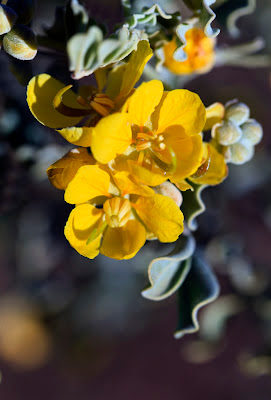
Cassia


It was a beautiful spot, all the more so because it was so unexpected. 

Hooded robin

Tuesday, 21 August 2012

Punda heart

We went back to Punda Pool on our way home 'cause we loved it so much. And yes, our solar shower was still swinging in the breeze from the giant river gum.


I learnt from this - don't let cold water stop you from placing the rocks in the right place right from the beginning - and reflections don't move in the water as the sun goes down - just the colours change - it seems obvious now - but I didn't want to get cold and wet at first - so I built it in the wrong spot - it was a bit of fun though.


Wanna Munna

On the subject of artworks, here is a slip back to our time in the Pilbara. We called in to Wanna Munna which is about 75km out of Newman and relatively close to the main road. It is an Aboriginal rock art site straddling a water hole. Unfortunately there is a bit of graffiti at this site, probably because it is so close to the main road to Port Hedland. However I won't give electronic space to the graffitist efforts.

Wanna Munna boomerangs


Just to put the site in context here are two images looking upstream, where the majority of work is to be seen, and downstream where there is a beautiful jumble of rocks in the river bed.

Wanna Munna main pool upstream


Wanna Munna looking down stream


Some of the images picked on the rocks were very faint, and in places layered one on another. Presumably some of them are very ancient but again I can find little information about them. There were images of emus, kangaroos, spotted cats, figures - people?and boomerangs. It requires a high degree of skill to chip out such simple, elegant and true likenesses from hard and unforgiving granite boulders.

Wanna Munna rock art


Wanna Munna rock art emu and kangaroo


There were many birds here too - zebra finches, budgies, white naped honey eaters, mudlarks, corellas, willy wagtail amongst others. A large bird of prey flew in, a whistling kite, and off went all the other little birds.

Wanna Munna rock art figure


To finish here is an image of a tree that has defied the odds growing in a rocky crevice. They amaze me how they manage to do it.


Friday, 27 July 2012

Our winters are warm

Our summer is hot
And water is precious

These words are written on the town water tank on the top of a hill overlooking Marble Bar. Marble Bar has a reputation for being hot and is surrounded by low hills in the middle of the Pilbara, I suppose it is not surprising. All that heat absorbed by the bare rocky ground and then trapped in the hills. They have a record of 160 consecutive days over 38.7C (the old 100F) from the summer of 1923-24. However we had cold nights and warm days whose maximum didn't go over 30C.

Early morning shadows on the water tank


I climbed the Water Tank Hill a couple of times. At dawn I was fascinated by the rich blue shadows on the tank cast by the early golden sunlight. The distant hills glowed orange red with deep purple shadows.

Overlooking Marble Bar town


Speaking to a Queenslander enjoying the warmth, who had plans to stay a while hunting for gold, she said the locals told her "You'll be gone by the end of August - it'll be too hot for you!" She thought she might last a bit longer than that. I know I'd certainly be hightailing it out of there before the heat set in.


Government buildings Marble Bar


Gold was found here in 1891 and the town was established in 1893. The Government building, still being used for government services was completed using local stone in 1895. It is undergoing some renovations at the moment. If you look closely at the photo the scaffolding is just visible.


Banded jasper or 'marble'


Marble Bar is named for the banded jasper which crosses the Coongan River just out of town. The reds, blacks and creamy white stripes reminded the pioneers of marble. It is quite startling where it is visible, although most of the bar was covered in a layer of dried mud when er were there. A few hardy bodies splashed in the pool of water there, but it looked a little unappealing to me, muddy and greenish.


Pippunyah solar diesel power plant - solar arrays


There is a state of the art solar diesel power station just out of town. It supplies power for both Marble Bar and Nullagine. A few stats: it saves about 223,000 litres of diesel and avoids 600 tonnes of CO2 emissions by supplying 1150mwh of  solar energy per year. Quite impressive.

Grevillea flowers


Every now and again we would come across these grevilleas in flower. The birds just love them for their nectar and there are always a variety of honeyeaters to be seen and heard near by. In the water courses the eucalypts were heavily in bud. From the top of the hill you could track the water courses by the lines of trees snaking their way through the hills.

View from Tank Hill in early morning and walker in blue


Monday, 9 July 2012

Punda Pool

After being thrilled to see the Punda Aboriginal art site we drove a few kilometres further to Punda Pool on the Coondiner River. The track is a bit rocky and has some steep dips on which our trailer hitch bottomed out. However it was worth it as this was a fantastic place to camp.

Campsite in early morning at Punda Pool


 There is a long pool of fairly shallow water in a rocky pebbly riverbed. Surrounding this are richly coloured rocky hills covered in spinifex and gnarly white trunked gums ans flowering grevilleas and acacia's golden blooms just beginning to open.

Miske beside Punda Pool 


In the mornings and the evenings the hills glow with amazingly rich colours. To fully appreciate the morning colours you need to brave the extreme cold - I had to resort to wearing woolly gloves when up and about in the early dawn light. The nights were crystal clear, no cloud cover to keep the warm air in.

Home sweet home beside Punda Pool

However by mid afternoon it was warm enough to shower out in the open. We set up our shower under this big old tree - it is still there - we forgot about it and left it there. Oh well, ready for the next happy camper.


Looking from river bed to the hills


This image shows the amazing contrasts in this area, colour and texture. Rounded riverstones and rugged hillside rocks, smooth tree trunks and spiky spinifex. And I haven't even mentioned the birds - they were amazing. Flocks of crested pigeons, spinifex pigeons, diamond doves, zebra finches, budgerigars (by the hundred) and corellas. We saw the more secretive painted finches which the bird book describes as having the red of the hills, the black of the shadows and the white of quartz rocks - they are beautiful. Then there were the honeyeaters and mudlarks and black faced cuckoo shrikes and then the birds of prey here to hunt the plenitude of smaller birds.

Budgies waiting to drink

Budgies in flight above Punda Pool


 I was up early recording the dawn chorus and later the sound of hundreds of budgies wheeling and settling and wheeling again as they were harried by the whistling kites. Mark took some photos of them with his better lens. It is quite a different sight seeing them in the wild compared to the commonly seen cage birds.


Scar tree at Punda 


Finally, in addition to the nearby rock art site there is other evidence of the Aborigines who once lived and roamed in this area. In certain seasons it must have been a rich place to live. I have come across a few of these scar trees where shields and coolamons etc were cut from the trunks of trees.