Showing posts with label river. Show all posts

Sunday, 9 March 2014

Awakenings

Yesterday it drizzled on and off under cloudy-ish skies. Out walking the dogs in the afternoon I was surrounded by the rubbery cricks of tiny frogs that live in the karri forest. Only three millimetres of rain but just enough to wake the frogs. Almost autumn.


In the afternoon I and many others witnessed the sand mandala dissolution ceremony performed by the monks that had been working on the mandala since Tuesday.


The Tibetan monks hail from the Tashi Lhunpo Monastery in India and were accompanied by the Tibetan, Tenzin Choegyal, a singer, songwriter and musician. While in town they created the mandala over five days, gave workshops and guided meditations, and performed in a concert on Friday night.  Tenzin Choegyal has the most amazing voice and the monks were surprising.


They had an instrument that looked like a flared didgeridoo and had a deep and resonant sound reminiscent of throat singing. It was a Tibetan horn or dungchen. It was used in accompaniment to their chanting and throat singing. Parts of their ritual would wake any slumbering spirit. It must have been quite amazing to hear in the mountains of Tibet.


The mandala was 'dissolved' then collected up and we all walked to the river. For the finale of the ceremony the sand and petals were poured into the river after a final series of chants.


Wednesday, 17 April 2013

Beaufort Inlet

We arrived at Millers Point in the afternoon warmth, as small black coots swam low in the water and left a wake of tiny sparkling suns.

Coots feeding

Millers Point juts out into the Beaufort Inlet on the Pallinup River and the campsites are scattered among straight trunked eucalypts and twisty paperbarks.


From our spot we could see and hear the distant ocean which pounded on the bar to the south east and look around to the north west where the broad expanse of water disappeared behind hazy blue hills.


Looking inland

It is quite obviously a haven for fisher folk. The other campers took off early in the morning and returned in their dinghies late in the afternoon, leaving the point deserted apart from us and a couple from the eastern states.


The quiet thrum of generators that preserved their catch was the only human made sound to be heard during the day. Late in the afternoon the pelicans flew in waiting for the scraps from the returning fisher folk. The pelicans gave an occasional grunt; perhaps a 'hurry up and feed us' or a 'it's all mine not yours'. I don't know.


In amongst the rocks I found piles of silvery discs, the relics of successful fishing ventures.
The sandy beaches were covered in webbed footprints.


An old sign whose original intent has long since been lost


We walked to the lookout through a beautiful glade of eucalypts with trunks of ochres and greys.


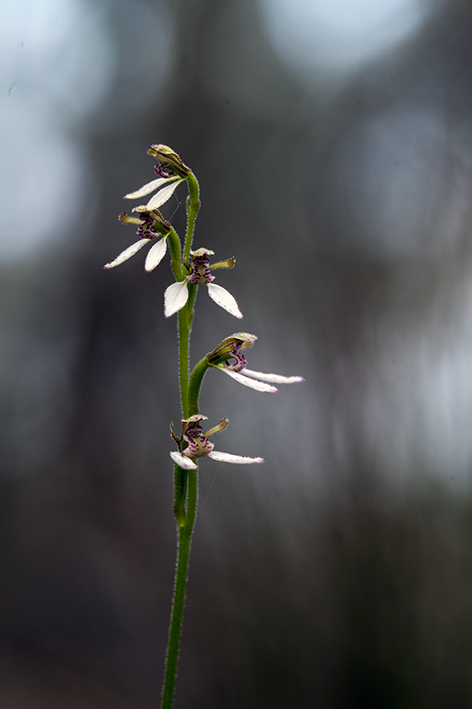
 In the thick mulch below grew autumn flowering bunny orchids.


And on the fallen branches grew these lovely lichens.


The view from the top past flowering Hakea laurina towards the bar and ocean.


According to South Coast Rivercare the Pallinup River rises in The Yilgarn Plateau south of Katanning with some salt lakes draining into the catchment in wet years. All the river is saline to some degree. The salinity has increased since clearing in the catchment region especially since the 1950's. Melaleuca cuticularis (saltwater paperbark) and Eucalyptus occidentalis (yate), are found growing here as both do well in saline conditions.

Saturday, 29 December 2012

Water dreaming

Summer has finally reached us down here in the south west, with warm sunny days, blue skies and high humidity. Nothing like the dripping heat one experiences up north or the baking heat of the inland. My brother and his wife, who live in Broome, spent a couple of days with us recently. We breakfasted outside in the morning sunlight, a gentle breeze wafting over our skin, and they felt cold. We thought it was perfect. Up in Broome they'd be dripping with sweat before breakfast was done. Our maximum temperatures are their minimums!

Despite the contrasts, the heat of summer brings to mind enticing visions of cool water. Down here we have  rivers with tannin dark waters and pristine beaches of white sand, rounded grey granite washed by cold azure seas. Up north, the beaches are washed by warm waters that can disappear into the distance with the huge tides, and the inland pools have fish lurking in the shadows, visible if you are still and quiet. In the wet after a good cyclone there can water as far as the eye can see.

It is those inland pools that remind me of the work of Sonia Kurarra. We saw some of her paintings when we were last in Perth at Form Gallery and it was great to see her work up close as I had only seen digital images previously. Her colours are rich with the reds of her homeland and vibrant contrasts. Nothing says sweltering humid summer more to me than shimmering hot pink and orange red. Barramundi  appear and disappear within her expressive brushstrokes.


The river near Noonkanbah (Yungngora)

Kurarra is from the country around Noonkanbah (Yungngora) and the Fitzroy River in the Kimberley region of  Western Australia, not too far from Broome. She paints the billabong country of the Fitzroy, and the fish - barramindi (parlka) and catfish (kurlumajarti) - that are important food species. Other themes that she paints are also related to traditional life; the rocks where the fish is cooked (parrmarr), coolamon for carrying things (ngurti) and boomerang (karli).


Barramundi dreaming

In 2010 Kurarra won the Western Australian Indigenous Art Award and the port Hedland indigenous art award. This year she won the Most Outstanding Work at the Port Hedland Art Awards for her work Martuwarra (Kurarra's river country).


Parlka (Barramundi) and rockholes 2010

Images are from WA Art Gallery and Short Street Gallery.

Tuesday, 24 July 2012

Swans at midnight


The road in to the campsite


Yes, I did really get up after midnight to sit on the bank of Carrawine Gorge to listen to the swans feeding and bugling. It was cold but I was well rugged up complete with quilt wrapped around me. Scorpio hung in the sky above the gorge wall opposite me and the moon was not yet up. From the darkness came the sounds of water lapping on the shore, gentle liquid sounds as the swans pulled up water weeds and their calls in duplicate, echoing back and forth across the pool. Occasionally a grebe dashed dashed across the water or the more strident duck's 'warrk, warrk, warrk' interrupted the tranquility of the night.

Swans feeding 


Carrawine Gorge at sunrise


Carrawine Gorge on the Oakover River  is more or less on the edge of the Great Sandy Desert, just off the Woodie Woodie Rd. One side of the gorge is a tall rocky cliff and the other has a little grass beneath trees, a wide expanse of deep stones surrounded by an arid stony landscape. The best way to get through the expanse of stones was to let your tyre pressure down - a bit like going through deep sand. Obviously the deposition of a few decent floods.

Carrawine Gorge at dawn

The pool is huge, wide and long, and supports a wide variety of wildlife. Camped on the edge it simply invites relaxation: one can sit for hours just looking and listening. The colours of the gorge and waters changed dramatically through the day. Hopefully the photos will give you a taste for the colours!


Reflections 


The most surprising sighting was a white bellied sea eagle flying along the gorge as we were about 200km inland. There were a number of reed warblers feeding in the reeds beside our campsite - I hadn't seen or heard them before at such close range. We were of course visited by cattle feeding on the grasses beside the water. They were red, just like the dust, with the conformation typical of tropical breeding.

Camp visitor


Monday, 9 July 2012

Punda Pool

After being thrilled to see the Punda Aboriginal art site we drove a few kilometres further to Punda Pool on the Coondiner River. The track is a bit rocky and has some steep dips on which our trailer hitch bottomed out. However it was worth it as this was a fantastic place to camp.

Campsite in early morning at Punda Pool


 There is a long pool of fairly shallow water in a rocky pebbly riverbed. Surrounding this are richly coloured rocky hills covered in spinifex and gnarly white trunked gums ans flowering grevilleas and acacia's golden blooms just beginning to open.

Miske beside Punda Pool 


In the mornings and the evenings the hills glow with amazingly rich colours. To fully appreciate the morning colours you need to brave the extreme cold - I had to resort to wearing woolly gloves when up and about in the early dawn light. The nights were crystal clear, no cloud cover to keep the warm air in.

Home sweet home beside Punda Pool

However by mid afternoon it was warm enough to shower out in the open. We set up our shower under this big old tree - it is still there - we forgot about it and left it there. Oh well, ready for the next happy camper.


Looking from river bed to the hills


This image shows the amazing contrasts in this area, colour and texture. Rounded riverstones and rugged hillside rocks, smooth tree trunks and spiky spinifex. And I haven't even mentioned the birds - they were amazing. Flocks of crested pigeons, spinifex pigeons, diamond doves, zebra finches, budgerigars (by the hundred) and corellas. We saw the more secretive painted finches which the bird book describes as having the red of the hills, the black of the shadows and the white of quartz rocks - they are beautiful. Then there were the honeyeaters and mudlarks and black faced cuckoo shrikes and then the birds of prey here to hunt the plenitude of smaller birds.

Budgies waiting to drink

Budgies in flight above Punda Pool


 I was up early recording the dawn chorus and later the sound of hundreds of budgies wheeling and settling and wheeling again as they were harried by the whistling kites. Mark took some photos of them with his better lens. It is quite a different sight seeing them in the wild compared to the commonly seen cage birds.


Scar tree at Punda 


Finally, in addition to the nearby rock art site there is other evidence of the Aborigines who once lived and roamed in this area. In certain seasons it must have been a rich place to live. I have come across a few of these scar trees where shields and coolamons etc were cut from the trunks of trees.

Sunday, 8 July 2012

Pilbara rivers and watercourses

One of the things one does when travelling up here is skip from watercourse to watercourse, and pool to pool. The rivers rarely run except after rains, and consist of a collection of waterholes between lengths of dry riverbed. The surrounding countryside is fairly arid in comparison to the lush greenery around the water.

Just before Newman we had lunch at the south branch of the Gascoyne River. It is a pretty spot, a small still pool of water, slim paperbark trees with silky foliage and shady white trunked eucalypts following the winding course of the river. While Mark tried to photograph a whistling kite stalking the flocks of birds coming in to drink, Miske and I walked downstream to see what we would see. I came across this wonderful twisted tree branch.

Gascoyne River view, south branch


After Newman we drove out to Kalgan Pool, for which we had to get a permit from the tourist bureau in Newman to use a short section of the BHP road. Kalgan Pool is a popular spot with the locals, being so close to town. The road in is normal 4wd. There were a couple of other campers there while we were there. The main pool is at the base of a large red rockface, lined and contorted, and there are a series of other pools within easy walking distance along the watercourse. I explored a few gullies and clambered up part of the side of the gorge overlooking the pool and campsite. It was beautifully warm in the early morning sunshine, while the camp was still in deep shade and very chilly. Softer grasses grew in the gullies - lemon grass and wallaby grass while spiky spinifex grows higher up. Miske soon learnt to tread carefully once we left the gullies. The flowers of Wickham's grevillea and eucalpyts were busy with little honeyeaters.

View from side of gorge, our camp is down there

Miske beside Kalgan Pool in the morning


There were some lovely acacia's with minni ritchie bark growing in the first gully I walked up. I love it with the sun shining behind it, highlighting the curls.

Minni ritchie bark

We passed the galahs on our way in, feeding beside the railway line. The background is typical of the country surrounding the watercourses.


Pink and grey galahs


Saturday, 21 April 2012

Of rivers, tall trees and tales

As part of an Arts Practicum unit of study earlier this year I participated in a community performance project. It was designed around a series of workshops covering textiles, writing and performance, directed by local choreographer Annette Carmichael. The project Solace + Yearning: Between Kwoorabup and Denmark was part of Denmark's community arts festival Brave New Works #19. It culminated in a series of five site-specific performances on the Kwoorabup Trail along the banks of the Denmark River (Kwoorabup Beelia).

You can watch a You Tube video of the making of Solace + Yearning. 


Solace + Yearning was a contemporary abstract performance aiming to reach the emotional heart of our connection to country and to invite the audience to begin to see the complexities and contradictions of our indigenous and settler histories. We wove stories along the trail, shared histories and culture, incorporated written and spoken text, music and song, dance and performance. The silks for our costumes were dyed with local plant materials so fitted beautifully in the environment. The audience moved along the trail with us making it an extremely intimate experience.  We worked out under the cool of the tall karri trees or in the baking heat of the paddock. As summer wore on the karri shed silver and rust bark strips to expose cream gold trunks, covering the path. We had to contend with stinging march flies after the rain and bull ant bites if we ventured too close to their nests. Despite this, I found the whole experience to be intense, inspiring and enriching. It was great to be playing with textiles again and performing was a new challenge for me which is always good for the soul.

The below web address will take you to a photostream for the performance.

http://www.flickr.com/photos/denmarkarts/sets/72157629568831307/with/6829814732/