Showing posts with label birds. Show all posts

Tuesday, 7 October 2014

Balijup in Spring

I returned to Balijup last week. Having only seen the landscape under the summer heat and walked over dry lakes I was keen to see the changes after some rain. I had window of opportunity and I took it. This is what I found.


Water in all of the lakes. Even a few ducks and herons around.


 On the back lake there were even some swans but I didn't get out there. I only had a day. As it was I managed to get to six of the lakes and swamps on the property. There are a lot of wetlands there. I still find it amazing.


Beautiful golden button flowers carpet the ground on even the badly salt/alkaline affected lakes. 


The reflections were to be savoured.


As were the spring flowers.


And lichens.


Golden sticky modified leaves of a carnivorous Drosera.


Continuing the golden theme - a canola paddock. Last year this was a hay crop. 


A scarlet robin entertained me while I ate my lunch. Flying down to catch insects then up into the tree to look out for his next victim. The female was much more circumspect.


Sunday, 8 June 2014

White robin


Over late summer and into autumn we were graced with the antics of a pair of white robins flitting and feeding through our garden. Early in April I flushed a fledgling from some shrubs near the chook yard.. It flew straight out in front of me with the parents looking on from near by. After staring at me for a moment it flew into the bush next door. These are the photos I took of it feeding in our garden on subsequent occasions. It looks a little scruffy because it still has some of it's baby fluff.

Unfortunately this story has a sad ending. I found the poor little bird dead one morning at the end of April. Soon after that I found the White robin's nest in my shade house - a well built little cup of woven grasses nestled in the fronds of a large elkhorn. No wonder I saw the adults so frequently. Since then I have found an older nest in another elkhorn. With a bit of luck they will try again and this time with more success.


Silver shimmer

Walking down by the inlet the last few days the water has been a gentle reflection of the pale cloudy sky.


The water birds are making the most of the still shallow waters - easy fishing and feeding on the water weeds in the shallows.


A flotilla sails by.


Spoonbills taking time out from feeding.


An ibis comes in to land.


The lichen covered rocks glow in the late afternoon light.

Monday, 26 August 2013

Pools and twisted gums


Just north of Meekatharra we again stopped at Bilyuin Pool. It is a great spot to camp with a long permanent pool in the middle of dry flat mulga country. On both our visits the surrounding country has seemed bare, grey and drought stricken. The pool is on the headwaters of the Murchison River, which true to form for northern rivers, is not so much a river, but more of a watercourse and occasional river. This is station country and the cattle came in for a drink in the morning, and mooched around munching on the green feed in the watercourse, keeping their distance from us of course.


 We camped beside the big pool this time, the other smaller pools were dry this visit.

Our camp is under the white gums on the distant left

There were a different range of birds this time. I loved watching the black-tailed native hens grazing on the short grass on the pool edges and feeding in the shallows. They behave rather like chooks, just very shy, running through the shallows and taking off into the bush when disturbed.


Black-tailed native hens

There were both black fronted dotterels and red kneed dotterels feeding by the water's edge.

Black Fronted Dotterel with worm

Away from the watercourse country I saw pairs of red winged wrens feeding in the shrubs. Black faced cuckoo shrikes blended in beautifully with the colours of the white gums. 


Black-faced cuckoo shrike

I love the forms of massed white gum trunks and the twisted shapes of branches against the blue sky.


More shades of black and white. The ubiquitous willie wagtail. Always cheerfully chirruping and flitting over the water after insects. One morning a willie wagtail attacked a crow down by the waters edge, then four white plumed honeyeaters promptly attached the willy wagtail, chasing it across the water. Nesting season must be in full swing.


And finally, a Nicotiana flower sprouting from a sandy watercourse.


Thursday, 7 March 2013

Walking in Harewood

When we first walked this trail eight years ago it was a one hundred year forest. 


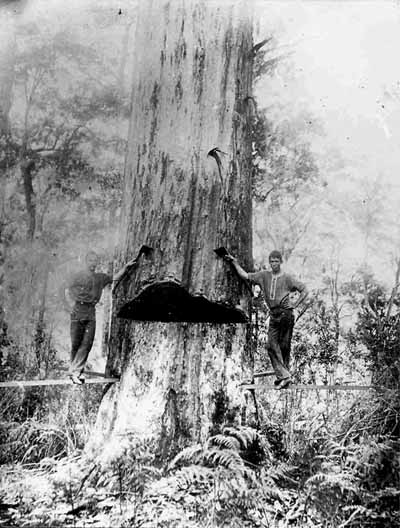
This hillside was part of a much larger logging holding that was taken up by the Millar brothers in 1895. The Millars opened their first mill in Denmark in 1893 and by 1905 all three of their mills were closed. By then the loggers had clear-felled all the ancient karri trees, and left a bare and ravaged landscape.

Timber cutters working on karri tree (Denmark Historical Society)

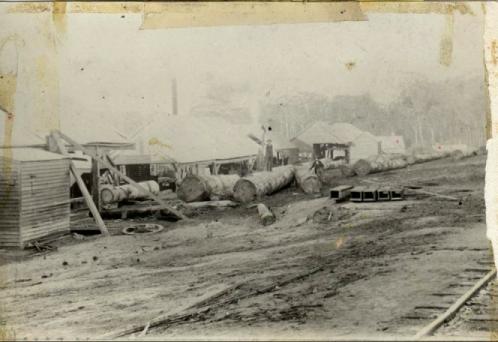
The demand for timber had been so high that the millers worked night shifts as well. Can you imagine working on a cold wet winters night with sharp steel blades, noisy machinery and massive timbers - by the light of kerosene lamps? 

level7mill.jpg - 27Kb
Old timber mill  (Denmark Historical Society)

It is quite different now. The steepest parts were abandoned and the bush re-covered the hillsides. Over time the gentler muddy red curves were coaxed into grassy green mounds by new settlers. Pretty but challenging. Today the patchwork of forest, pasture and vines is as varied as the people that now live there.

Last weekend we walked in this forest as summer gave way to autumn. As we arrived a deep indigo cloud dumped its load and a couple with a young child sheltered in their car. 

The rain had coloured up the mosses and lichens and frogs sang in their freshly moistened skins.


A fantail peeped close by as it flicked and fanned its tail


Old bark turned back


Shadows played


Strands of discarded summer trailed high overhead.


Cream karri trunks ready for the new season


The allocasuarina's deep corky bark flaunted the past, hid the present

  
Red winged wrens danced a duet  through the undergrowth


Tannin dark water rippled over black slippery rocks


In a pile of fallen bark at the base of a one hundred and eight year old tree, the child told us he was making a special spot for the forest fairies.


Did you have secret fairy spaces in your childhood? I did. I remember a special place at the top of our bush block in Parkerville. It was nestled in an ancient burnt out tree stump. The floor was mossy green sheltered by the jagged charcoal edges of the stump. In the hollowed middle green snail orchids grew as high as a fairy's waist. Outside in spring bright yellow cowslip orchids bloomed. In grade one we had a spot in the bush above the school. This place was encircled by grass trees and it too had orchids; from memory they were tiny pink fairy orchids.

I nearly missed the beauty of the reflections in the creek. It was only when I sat down on the rocks in the creek - slowed down to watch the wrens - that I saw them. Special places - it doesn't take much really - slowing down, seeing, imagining.