Showing posts with label textiles. Show all posts

Thursday, 30 January 2014

String and contemporary textiles

I've just come back from a quick trip to Perth to catch up with friends that I haven't seen for ages and I managed to fit in a few exhibitions as well. I was impressed by String Theory at PICA (Perth Institute of Contemporary Arts). I managed to catch it on the last day. It is a travelling exhibition from the Museum of Contemporary Arts Australia and features the work of  more than thirty Australian Aboriginal artists and artist groups. The majority of the works have some relationship to textiles or the tactility of craft working. This ranged from printmaking to fibre sculptures, photography to doll making, to more contemporary installations and video.


Some of my favourite works were the life size sculptures by  Niningka Lewi, Minya Punu Kungkarangkalpa (The Seven Sisters),2013. They were made from grasses and other fibres and were marvelously animate and colouful. I thought they were great and it looks like the kids in the image below thought so too.

Photo: This show is pretty wild! Come check out the enormous STRING THEORY exhibition- opening Friday 15 November, 6pm! 

https://www.facebook.com/events/220549558106565/

Photo: gorgeous kiddies checking out the seven sisters by the Tjanpi Desert Weavers at PICA today

There was a collection of strings made from traditional materials bark fibre and feathers, strong and delicate. The work below is by Frances Djulibing, Yukuwa (Feather string yam vine), 2013 made from banyan tree bark, cockatoo feathers and beeswax. This was a large suspended installation was wafted delicately as you moved around it.

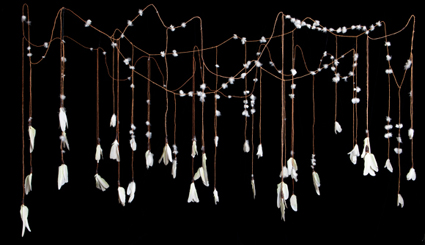

Frances Djulibing, Yukuwa (Feather string yam vine), 2013. Banyan tree bark, cockatoo feathers, beeswax. Museum of Contemporary Art, purchased 2013. Image courtesy and © the artist


The painting below was traces the twining patterns found in dilly bags. It is by Regina Wilson, Wagardi (Dilly Bag), 2010.


The work below is by Dale Harding, Bright Eyed Little Dormitory Girls, 2013, one of a series in the installation.


In the video you get a glimpse of a series of lace collars with leather which really grabbed me in the heart. I'm afraid it reminded me of Roebourne Prison which I visited a few years ago and found it a very traumatic experience. I'm sure the work referenced young Aboriginal girls being forced to work as house maids but for me it had overtones of the terrible neck chains used on Aboriginal prisoners .


There was a series of colourful artline works by Jimmy Pike all part of the UWA Berndt Museum collection which I thoroughly enjoyed . 'Headband', illustrated above gives an idea of the richness of his work. Coincidentally I am reading You Call it Desert - We Used to Live There by Pat Lowe with Jimmy Pike. This book describes life in the Great Sandy Desert as lived by small family bands before the arrival of  kartiya (white people) and the changes to the land and cultural practices since then. It covers things like waterholes,  tools, medicine, children's games, birth and death, and the Walmajarri language. The easy to read text is complemented by many photographs and Pike's drawings and paintings.

It was a great show and I thoroughly enjoyed it - the only downside was that the catalogues had sold out - good for PICA bad luck or me. Coincidentally I subsequently met the photographer responsible for the images for the catalogue while minding the Butter Factory Gallery down here. She said the artists had some amazing stories to tell, particularly the stories associated with the dolls. (The video gives a glimpse of the collection. I tried to embed the video but couldn't make it work so you need to follow the link.)  

I wrote this on the tenth but for some reason didn't publish it, so here it is now.


All images from the PICA website and PICA Facebook or the UWA Berndt Museum website..

Tuesday, 26 March 2013

Stitching Punda

Last night it rained, in fact it bucketed down. Strong winds, lightning, thunder, the whole works. This morning the roads are strewn with long strips of karri bark, leaves, branches and lumpy streaks of ginger gravel left by the gushing runoff. In fact we had over forty millimetres of rain.

It seems kind of appropriate that last night I finished working on a garment that was inspired by the floods up north.  I made a printing block using some flood detritus while we were camped at Punda Pool near Newman last year. 


I used this to overprint some cloth, then added a small sprouting banksia print and some simple stitching. The coup de grace was a tiny heart of french knots which is my connection to the heart I built in the pool while we were there. It is the red of the dirt and the rising and setting sun.


I smile just thinking about that place.


Monday, 4 March 2013

Time flies

I've been missing in action for quite a while. Life is like that sometimes. This month I hope to get back on track.


I have been preserving fruit. Damson plums - they make the most delicious plum jam - but they are fiddly, being small and cling stone. I bottled some too and they look great. The twenty eight parrots feast on the fruit high on the tree, while the chooks get the windfalls.


Brave New Works 20- Joey Williams
Joey Williams

I have been rehearsing two nights a week for Joey Williams' Songlines project. It is a cross cultural performance expressing the story of his family songline, performed in part to honour the memory of his father who died last year. His family totems are all the forms of fire - smoke, embers, fire sticks, sparking fire and flaming fire.


It was also an excuse to dye up some fabrics for our costumes - earthy and reminiscent of skins. Out came the dyepot and in went silks and cottons and karri bark, eucalypt leaves and rusty iron.


I have done some sewing as well, using fabric I had dyed and printed.


I have been helping to build the red tent, with many other woman, for Sarah Martin's Red Tent Project. It is a big geodesic dome built from bamboo struts and leather hubs, all bolted together and covered with a zipped together red vinyl covering. It is envisaged as a safe and nurturing space for woman.


I have been to writing workshops with Linda Bradbury as part of the Red Tent Project series of workshops. I managed to get to one of the Write in the Great Southern author talks.

Image by Bharat Sikka


We have been to Perth to catch up with family and attend the opening of the Pilbara Stories exhibition at Form Gallery way back in early February. The exhibition runs till 20th April. To get the best value from this exhibition the stories that were collected at the same time need to be read in conjunction with the images. The photographers are Martin Parr, Ketaki Sheth, Bharat Sikka, Annet van der Voort and John Elliott.


Image by John Elliott

And there have birds congregating on the inlet and pretty sunsets in amongst it all.

At the fisherman's jetty at Crusoe Beach


Pelicans and cormorants


Tuesday, 19 June 2012

Salt


Salt affected land in the Jerramungup region

Salinisation of our farmland in our wheatbelt is a serious problem and has been for a considerable time. This week I watched A Million Acres a Year (directed by Frank Rijavec, 2002), a story of government endorsed clearing of land in the south west after the second World War. A million acres of virgin bushland was released for agriculture every year from 1959 to 1969, with little consideration as to whether the land was suitable for agriculture. This was done in the government interest to create new townships and industry, provide for returned servicemen, and make good use of 'valueless unproductive bush'. As part of the conditions the landholder was obliged to bulldoze and burn the bush or risk losing their land. The stories of the clearing and burning I always find hard to take - the native animals had nowhere to go - it is horrific to contemplate. As Kaye Vaux writes in her poem The 1980 Nightmare,
'Man had a dream in the 1950s.
the bush flattened on its back tanned in the sun ...
Sap hissed in tongues of flame.
Tiny creatures lost their souls
in great mushrooms of smoke higher than heaven.'
The farms were generally cleared with little left standing for animal shelter, windbreaks or species habitat. Landowners who wanted to keep some areas uncleared had an uphill battle to do so.


As exhibited at Riseborough Gallery in Gin Gin


This film reminded me of the series of small objects I made in response to the threats to biodiversity by salinisation. they are less than 100mm high and made from silk, metal and salt. Their shapes are derived from flowers found in the wheatbelt. According to ANZECC (2001) wheatbelt salinity has led to a 50% decrease in the number of wetland bird species and threatens around 450 plant species with extinction in this region.


In the film Don Cochrane states that it had been known for over 100 years that clearing natural vegetation caused dryland salinity and land degradation. In 1897 steam train drivers reported salinisation of water in catchments that had been cleared for farming. By 1951 the Public Works Department had recommended that clearing be banned in water supply catchments due to salinity problems. Despite this, War Service land was released in Jerramungup in 1953 and more generally land was released for agriculture from 1959. Three years of drought followed from 1969 eventually forcing many farmers off the land. I remember we had our first water restrictions in Perth then. Amazingly another 3 million hectares of land was planned to be released from 1979. However another three year drought beginning in 1981 put an end to that after 10% of south coast farms suffered from severe wind erosion. The state went from releasing land for agriculture to commencing landcare programs aimed at combating wind erosion and dryland salinity.


This tragic tale ends on a positive note as many local people and organisations realise that mistakes were made and try to halt the salt and land degradation. Typical of many landowners, Steve Newby explains 'in my case I feel I've got a responsibility to repair the damage that my family has done to this land before I finish with it'. The major fronts of attack on salinity are tree planting, drainage, growing perennial pastures, fencing of remnant vegetation and planting affected land with salt tolerant perennials like saltbush. At the end the film-makers acknowledge the Noongar people whose tribal country the film depicts and 'whose story is yet to be told'. They managed the land for thousands of years within a stable ecosystem of amazing diversity. In just 200 years settler society has wrought enormous changes to the land. there is a huge amount of work to be done to re-establish a sustainable, healthy and diverse landscape where all stakeholders are valued


For a few years I grew trees and planted them on farms as part of the Men of the Trees Farm Tree Help Scheme and also volunteered in their nursery. The nursery grows a huge variety of plants for major revegetation projects. I love going back to planting sites some years after to see how much the trees have grown. Immediately after the planting it looks like you have done virtually nothing, the plants are so tiny. I remember just after 4000 trees had been planted, the farmer whose trees they were exclaimed 'What have I done!' I can fully understand his horror. But, it is amazing what grows even in the most abysmal year when the crops shrivel up, the native plants hang on.


Established eucalyptus plantation on a Tenterden farm with salt affected land 

Link to salinity map for much of the south west here

Sunday, 10 June 2012

Textiles part two

Here are some more images from the exhibition currently on show at the Butter Factory Studios till 13th June. The works were created entirely by Denmark artists and community. They are the result of the community performance project Solace + Yearning: Between Kwoorabup and Denmark which was performed along the Kwoorabup/Denmark River back in March. The project explored a shared longing to connect to the natural world and the complexities of our shared histories since colonisation.


Costume
Performer Adrian Baer
Fabrics by Heather Coombes
Constructed by Yvonne Quinn
The striking central motif is from the contact dye of the bloodroot an unassuming plant growing in the lower lying areas around Denmark.


Installation the washing scene
Text on the basin S + Y words to Row, row, row your boat


Costume
Performer Nikki Green
Fabrics by Bev Seeney, Annie Usher
Constructed by Jennifer Barter


Costume
Performer Toby Boaden
Fabrics by Sarah Martin, Bev Seeney
Constructed by Sarah Martin


Saturday, 9 June 2012

Textiles at the Butter Factory

As I said previously, I was helping to set up an exhibition last week. It is an exhibition of textiles, photographs and a film from Solace + Yearning: Between Kwoorabup and Denmark. The exhibition is being held at the Old Butter Factory Studios in Denmark and is part of the Festival of Voice Fringe. Despite the cold and rain there was a good turnout at the opening last weekend. Here are some images taken in the Butter Factory. It was great to see the costumes in a gallery context.

All the textiles were dyed with natural materials found in the area. They were the result of a weekend workshop spent steaming and simmering silk and wool with bark, leaves and flowers and a variety of mordants. The costumes were worn in the performances of  S + Y earlier in the year.


Costume
Performer Sonia Dezius
 Fabrics by Catherine de Vos, Bev Seeney
 Constructed by Sarah Martin
Performance image by Michael Hemmings


Installation on  karri bark by Annette Carmichael
Text by Nicola-Jane le Breton
The text on the bark is the words that were written on the bridge 
'With less gravity
on this steady spinning world
we can hover somewhere between
tree and cloud
matching our footprints
 to leaf prints that
solder earth to sky'


Farming the land installation
 Costume
Performer Nigel Levinson
Fabrics by Heather Coombes, Annie Usher, Janine McCrum
Constructed by Janine McCrum
Performance image by Michael Hemmings


Close up of costume vest


Knots of history installation and the Margit
Costumes 
Performers from right Phillip G Light; Toby Boaden
Fabrics by Jennifer Barter; Sarah Martin, Bev Seeney
Constructed by Yvonne Quinn; Sarah Martin
Performance image by Michael Hemmings


Costumes
Performers Catherine Mercer; Christine Ritter; Janine McCrum
Fabrics by Sheila Ayling, Annie Usher; Robyn Lees; Janine McCrum
Constructed by Annie Usher, Annette Carmichael; Annie Usher; Janine McCrum


                                                             Back view of costumes


 Here are some images from the performance to help put the exhibition and costumes in their original context.


Bridge scene

Knots of history

Paddock dance

I touch the river

Saturday, 21 April 2012

Of rivers, tall trees and tales

As part of an Arts Practicum unit of study earlier this year I participated in a community performance project. It was designed around a series of workshops covering textiles, writing and performance, directed by local choreographer Annette Carmichael. The project Solace + Yearning: Between Kwoorabup and Denmark was part of Denmark's community arts festival Brave New Works #19. It culminated in a series of five site-specific performances on the Kwoorabup Trail along the banks of the Denmark River (Kwoorabup Beelia).

You can watch a You Tube video of the making of Solace + Yearning. 


Solace + Yearning was a contemporary abstract performance aiming to reach the emotional heart of our connection to country and to invite the audience to begin to see the complexities and contradictions of our indigenous and settler histories. We wove stories along the trail, shared histories and culture, incorporated written and spoken text, music and song, dance and performance. The silks for our costumes were dyed with local plant materials so fitted beautifully in the environment. The audience moved along the trail with us making it an extremely intimate experience.  We worked out under the cool of the tall karri trees or in the baking heat of the paddock. As summer wore on the karri shed silver and rust bark strips to expose cream gold trunks, covering the path. We had to contend with stinging march flies after the rain and bull ant bites if we ventured too close to their nests. Despite this, I found the whole experience to be intense, inspiring and enriching. It was great to be playing with textiles again and performing was a new challenge for me which is always good for the soul.

The below web address will take you to a photostream for the performance.

http://www.flickr.com/photos/denmarkarts/sets/72157629568831307/with/6829814732/