Showing posts with label wrens. Show all posts

Thursday, 5 December 2013

Blue mobsters

I was in the garden the day the blue wren fledglings flew the nest. 

I had watched as they built the nest in a prickly acacia right beside the path to the vege patch. A wren in the chook yard collecting feathers is a bit of a give away. Things went quiet for a while as the parents sat on the eggs, then once the babies hatched life got busy for them. That was when the rest of the mob joined in. There was a constant stream of them, catching food and delivering to the hungry mouths in the nest.   


That morning, I was seated on the deck, savouring the early sunshine and the last mouthful of my breakfast, cashews and craisins. Two tiny grey shapes flashed across the corner of my eye. They zoomed onto the verandah, rapidly followed by Blake who dived after them. One veered up and away, the other was hidden behind Blake's large furry body. I yelled and jumped up in an instant my heart in my mouth. Horror at he thought of the tiny baby disappearing down his gullet.


Blake pulled back instantly and I saw a little pile of grey feathers on the ground ... not moving. This was not looking good. I picked up the body, it was alive, unharmed, but had a tangle of spider webs ensnaring a wing and a foot. No wonder it bombed onto the ground. You should have seen the blue wren mob suddenly appear when I picked the baby up. I was surrounded by four grey females and three bright blue males all scolding me. Very unhappy mobsters. 


The fledgling felt so fragile as I carefully pulled the sticky web away. It was a delicate operation, the bird was tiny, just a few grams and the thinnest legs you can imagine. Finally free of web, I let it go, wondering how it could possibly fly at all, it had such a short tail and the bird was sooo tiny. But it was up and away onto the beams of the shadehouse. Soon the family were there beside it and normal feeding resumed.


This is the baby with a fuzzy parent in the foreground.


Thursday, 7 March 2013

Walking in Harewood

When we first walked this trail eight years ago it was a one hundred year forest. 


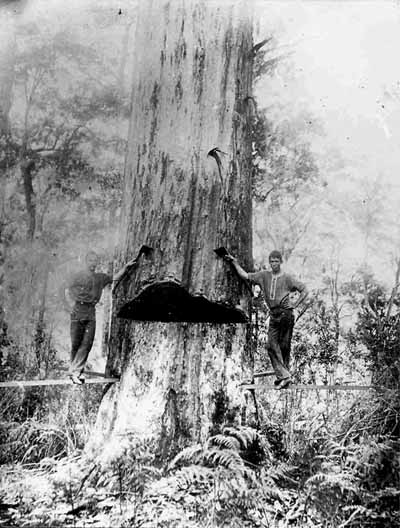
This hillside was part of a much larger logging holding that was taken up by the Millar brothers in 1895. The Millars opened their first mill in Denmark in 1893 and by 1905 all three of their mills were closed. By then the loggers had clear-felled all the ancient karri trees, and left a bare and ravaged landscape.

Timber cutters working on karri tree (Denmark Historical Society)

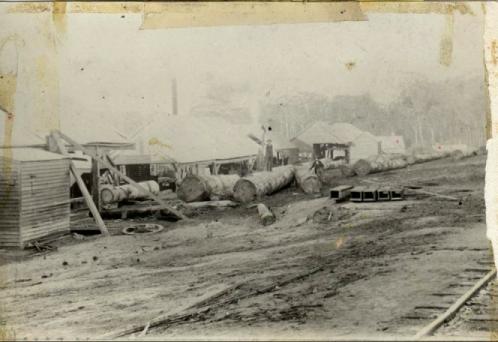
The demand for timber had been so high that the millers worked night shifts as well. Can you imagine working on a cold wet winters night with sharp steel blades, noisy machinery and massive timbers - by the light of kerosene lamps? 

level7mill.jpg - 27Kb
Old timber mill  (Denmark Historical Society)

It is quite different now. The steepest parts were abandoned and the bush re-covered the hillsides. Over time the gentler muddy red curves were coaxed into grassy green mounds by new settlers. Pretty but challenging. Today the patchwork of forest, pasture and vines is as varied as the people that now live there.

Last weekend we walked in this forest as summer gave way to autumn. As we arrived a deep indigo cloud dumped its load and a couple with a young child sheltered in their car. 

The rain had coloured up the mosses and lichens and frogs sang in their freshly moistened skins.


A fantail peeped close by as it flicked and fanned its tail


Old bark turned back


Shadows played


Strands of discarded summer trailed high overhead.


Cream karri trunks ready for the new season


The allocasuarina's deep corky bark flaunted the past, hid the present

  
Red winged wrens danced a duet  through the undergrowth


Tannin dark water rippled over black slippery rocks


In a pile of fallen bark at the base of a one hundred and eight year old tree, the child told us he was making a special spot for the forest fairies.


Did you have secret fairy spaces in your childhood? I did. I remember a special place at the top of our bush block in Parkerville. It was nestled in an ancient burnt out tree stump. The floor was mossy green sheltered by the jagged charcoal edges of the stump. In the hollowed middle green snail orchids grew as high as a fairy's waist. Outside in spring bright yellow cowslip orchids bloomed. In grade one we had a spot in the bush above the school. This place was encircled by grass trees and it too had orchids; from memory they were tiny pink fairy orchids.

I nearly missed the beauty of the reflections in the creek. It was only when I sat down on the rocks in the creek - slowed down to watch the wrens - that I saw them. Special places - it doesn't take much really - slowing down, seeing, imagining.


Wednesday, 6 February 2013

Red summer


This is the time of the year for the riot of colour brought to us by the red flowering gums, which grow naturally in limited coastal areas near here. Of course we grow them in our gardens, even though they can be a little touchy about conditions.


And the red winged wrens have returned after raising their young here in the garden some months ago. As soon as the babies were fledged and left the nest they disappeared into the bush. Just recently I have seen them flitting about the garden. The images below were taken on a particularly hot day. Nothing like a good splash to cool down and freshen up.


Tuesday, 20 November 2012

Taking turns

For a while I have been trying to get a photo of the red winged wrens that have finally ventured up from the creek line at the bottom of the garden up to the house garden. Lately we've seen the boy flitting close by, but each time I grabbed my camera he disappeared. Two weeks ago, while pruning the garden I came across a nest well hidden in the shrubbery with a couple of tiny pale speckled eggs nestled deep inside. The nest was made from woven grasses and cape gooseberry husks. Since then, I'd left the nest alone for a while trying not to disturb the sitting bird - at this stage I had no idea who the nest belonged to.


Female red winged wren


Yesterday I peeked into the domed nest and saw a couple of hatchlings. A female wren appeared on top of the nearby asparagus and scolded me. Time to check it out. Within ten minutes of sitting out with camera in hand, a little distance away from the nest, the male red winged wren took his turn at the nest. Jackpot! They took turns at the nest while the other parent hunted for food. The female disappeared within the shrub, whereas the male, after feeding the young, guarded the general area, looking about the whole time. At the change over, the returning bird called to the bird at the nest who called in reply, then they swapped duties.


Male red winged wren at nest


It will be fantastic when they leave the nest and we have a whole family of red winged wrens flitting through the house garden.

Wednesday, 15 August 2012

Flutter, flutter, bump

In the first light of the morning we woke to the sounds of flutter flutter bump, flutter flutter bump,
...  flutter flutter ...  'Sounds like an old lady moth bumping against the ceiling, trying to get out'.

But it's the wrong time of the year for that. Flutter flutter bump. 


It was a female blue wren attacking her reflection in the window, fluttering up and down in sync with her alter ego. Flutter flutter bump. She kept on at it till our movement sent her off into the garden. Minutes later she was back at the next window, chasing her reflection up and down the glass. Here you can see her rich chestnut eye mask.


Since we came back from our holidays, one of the first things we did was give all the windows a good clean. Obviously it was enough to spark this new behaviour from the wren. I find it strange that it is the female who is doing the attacking, I would have thought it was the domain of the male, but the males have been fairly circumspect lately. In our garden here we have both the blue wren and the red winged wrens flitting about. I love their voice, I call them our natural canaries. They all trill, males and females, perching high with their throats extended as they sing to the world.


Later in the morning a blue male came in to feed with a group of five other females and youngsters, his feathered coat sheening in the patchy sunlight. They are so delicate and light on their legs as they skip over the ground picking up tiny morsels that only they can see.


In the past I have found their nests hidden deep within the Hakea oleifolia that I planted in our garden. The foliage is suitably prickly and dense, and the shrub high enough, that the wrens can nest there secure from predators.