Showing posts with label wetlands. Show all posts

Tuesday, 7 October 2014

Balijup in Spring

I returned to Balijup last week. Having only seen the landscape under the summer heat and walked over dry lakes I was keen to see the changes after some rain. I had window of opportunity and I took it. This is what I found.


Water in all of the lakes. Even a few ducks and herons around.


 On the back lake there were even some swans but I didn't get out there. I only had a day. As it was I managed to get to six of the lakes and swamps on the property. There are a lot of wetlands there. I still find it amazing.


Beautiful golden button flowers carpet the ground on even the badly salt/alkaline affected lakes. 


The reflections were to be savoured.


As were the spring flowers.


And lichens.


Golden sticky modified leaves of a carnivorous Drosera.


Continuing the golden theme - a canola paddock. Last year this was a hay crop. 


A scarlet robin entertained me while I ate my lunch. Flying down to catch insects then up into the tree to look out for his next victim. The female was much more circumspect.


Tuesday, 8 July 2014

Martup Pool - a tale of deception

I don't know how many times we've driven past the sign Martup Pool on the trip to and from Perth, and we've never had the inkling to stop. Despite the word pool in the name. There couldn't possibly be a real pool there amongst the straggly grey trees - could there?? Surrounded by paddocks, sprouting crops and lambing ewes. In the middle of this country known for dryness??  


The farm dams are rarely full. The worn out creeks are usually dry with an occasional excuse for a pool glimpsed amid the saltbush and unhappy trees. Shallow and brown and generally unappealing, a far cry from how the country once must have looked.  I usually play a game of trying to glimpse any water at all, while whizzing past.


However on this latest trip to Perth I succumbed to curiosity and had lunch there. What a surprise. There creek was a winter creek babbling and winding between the greeny-grey sheoaks. Grass grew like bright green blankets tossed over the ground. This was pretty enough for a lunch spot and I would have been happy just with that.


But the track left the parking area and disappeared to the north between the trees. So I followed it with curiosity, through an enormous pool puddle over the road. Fun splashing through that! I caught glimpses of a real pool through the trees.


Eventually the track stopped at another parking area beside what could only be described as a billabong. Paperbark lined, wide and deep, and beautiful. According to the signage there it is permanent water and certainly looks to be still fresh. A.m.a.z.i.n.g. That is a ten year deception. It just goes to show that we sometimes have to let go of our Australian perceptions of what a pool is (usually pretty empty of water) and allow the dictionary meaning in ( a small and rather deep body of usually fresh water). Although this pool was BIG - hundreds of metres long.


 Now I realize there are a few other spots along this road that may hold similar surprises in store. I will be checking them out. I have been, and will be into the foreseeable future, making regular trips to Perth to help Dad with his writing. That is a project in itself - I'm just taking care of the technological side of things. So I will have plenty of opportunities to investigate ...


Wednesday, 17 April 2013

Beaufort Inlet

We arrived at Millers Point in the afternoon warmth, as small black coots swam low in the water and left a wake of tiny sparkling suns.

Coots feeding

Millers Point juts out into the Beaufort Inlet on the Pallinup River and the campsites are scattered among straight trunked eucalypts and twisty paperbarks.


From our spot we could see and hear the distant ocean which pounded on the bar to the south east and look around to the north west where the broad expanse of water disappeared behind hazy blue hills.


Looking inland

It is quite obviously a haven for fisher folk. The other campers took off early in the morning and returned in their dinghies late in the afternoon, leaving the point deserted apart from us and a couple from the eastern states.


The quiet thrum of generators that preserved their catch was the only human made sound to be heard during the day. Late in the afternoon the pelicans flew in waiting for the scraps from the returning fisher folk. The pelicans gave an occasional grunt; perhaps a 'hurry up and feed us' or a 'it's all mine not yours'. I don't know.


In amongst the rocks I found piles of silvery discs, the relics of successful fishing ventures.
The sandy beaches were covered in webbed footprints.


An old sign whose original intent has long since been lost


We walked to the lookout through a beautiful glade of eucalypts with trunks of ochres and greys.


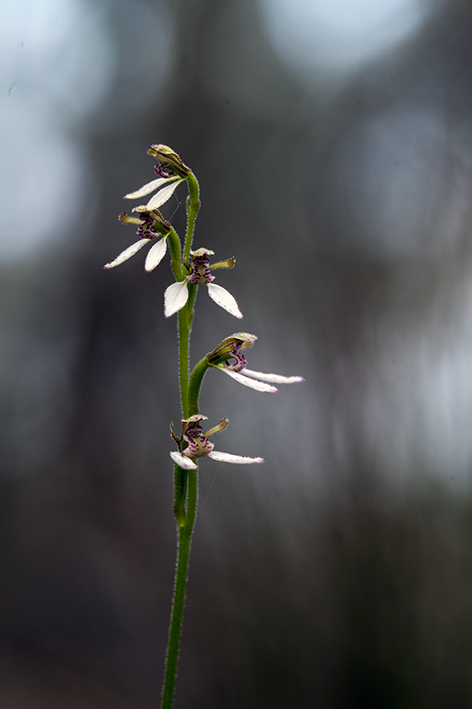
 In the thick mulch below grew autumn flowering bunny orchids.


And on the fallen branches grew these lovely lichens.


The view from the top past flowering Hakea laurina towards the bar and ocean.


According to South Coast Rivercare the Pallinup River rises in The Yilgarn Plateau south of Katanning with some salt lakes draining into the catchment in wet years. All the river is saline to some degree. The salinity has increased since clearing in the catchment region especially since the 1950's. Melaleuca cuticularis (saltwater paperbark) and Eucalyptus occidentalis (yate), are found growing here as both do well in saline conditions.

Monday, 9 July 2012

Punda Pool

After being thrilled to see the Punda Aboriginal art site we drove a few kilometres further to Punda Pool on the Coondiner River. The track is a bit rocky and has some steep dips on which our trailer hitch bottomed out. However it was worth it as this was a fantastic place to camp.

Campsite in early morning at Punda Pool


 There is a long pool of fairly shallow water in a rocky pebbly riverbed. Surrounding this are richly coloured rocky hills covered in spinifex and gnarly white trunked gums ans flowering grevilleas and acacia's golden blooms just beginning to open.

Miske beside Punda Pool 


In the mornings and the evenings the hills glow with amazingly rich colours. To fully appreciate the morning colours you need to brave the extreme cold - I had to resort to wearing woolly gloves when up and about in the early dawn light. The nights were crystal clear, no cloud cover to keep the warm air in.

Home sweet home beside Punda Pool

However by mid afternoon it was warm enough to shower out in the open. We set up our shower under this big old tree - it is still there - we forgot about it and left it there. Oh well, ready for the next happy camper.


Looking from river bed to the hills


This image shows the amazing contrasts in this area, colour and texture. Rounded riverstones and rugged hillside rocks, smooth tree trunks and spiky spinifex. And I haven't even mentioned the birds - they were amazing. Flocks of crested pigeons, spinifex pigeons, diamond doves, zebra finches, budgerigars (by the hundred) and corellas. We saw the more secretive painted finches which the bird book describes as having the red of the hills, the black of the shadows and the white of quartz rocks - they are beautiful. Then there were the honeyeaters and mudlarks and black faced cuckoo shrikes and then the birds of prey here to hunt the plenitude of smaller birds.

Budgies waiting to drink

Budgies in flight above Punda Pool


 I was up early recording the dawn chorus and later the sound of hundreds of budgies wheeling and settling and wheeling again as they were harried by the whistling kites. Mark took some photos of them with his better lens. It is quite a different sight seeing them in the wild compared to the commonly seen cage birds.


Scar tree at Punda 


Finally, in addition to the nearby rock art site there is other evidence of the Aborigines who once lived and roamed in this area. In certain seasons it must have been a rich place to live. I have come across a few of these scar trees where shields and coolamons etc were cut from the trunks of trees.

Saturday, 5 May 2012

Tenterden wetlands in the dry


Well they were dry really, but they would be wet in winter after some rains.

This biological survey weekend was organised by Greenskills in Denmark. It was part of the Gondwana Link Program. As part of this process we surveyed Melaleuca species growing on the range of wetland types found on the property. There was an interesting succession of wetland types ranging from those in pretty much original condition to ecosystems that were in a state of collapse to one that had adapted and recovered into a new ecosystem type. The changes in the wetland systems are due mainly to the large scale farmland clearing surrounding this property. The collapse of the Melaleuca species was accompanied by rising pH (alkalinity) and increasing salinity, a complexity I was unaware of having always thought it was just the salt.

Edge of healthy wetland system

This first image shows the outer edge of a healthy wetland. It is situated within a sandy bowl, with steep sides. Healthy banksia and jarrah woodlands surround it and even a healthy stand of Nuytsia floribunda. Mel. cuticularis (salt tolerant) and Mel. lateritia were the dominant species with a couple of  very large Mel. rhaphiophylla (likes fresh water) on the edges. In summer the Mel. lateritia is covered with bright orange-red flowers and is a haven for birds.
Healthy paperbarks in the middle of the wetland
The next two images show the difference between a healthy stand Mel. lateritia and a collapsed stand. Apparently the wetlands began to show first signs of change thirty years ago. The wetland on the left started to show signs of change in the last few years. Now it is all dead.  The character of the soil changes too with the loss of organic matter. It must be difficult to watch this happening knowing that this property has been largely uncleared and yet these changes are still occurring.

Collapsed stand - note the bare soil
Healthy stand of Melaleuca lateritia 

This image of a samphire covered depression was a Mel. Lateritia wetland that collapsed some years ago. It has now been colonised by the samphires which can handle the changed salinity and soil pH. It just goes to show the resilience of nature.

Samphire covered depression

The final images are from some paperbark swamps (dry) that are in the process of collapsing. In the first image we are testing the pH of the soil which was slightly alkaline. This swamp was once covered in tall sedges which have now all but disappeared. The paperbark trees Mel. cuticularis are still surviving. The image of another swamp shows the paperbark trees all dead. Around the edges the trees are still surviving. The current owners told us of playing in these swamps as children amongst the sedges and the bird life.

Testing pH in the middle of the dry swamp

Dead paperbark trees in the middle of another dry swamp

It is not all doom and gloom. The timber plantations should help to arrest the decline in the ecosystems. Some areas have been set aside for sandalwood plantations which will add another dimension to the enterprise. Over the weekend we saw and heard a large number of birds including the southern yellow robin, scarlet robin, wrens, a number of parrot species and lots of tiny birds. I saw most of the birds in the interface between the plantations and the wandoo woodlands. The fact that the plantation eucalypts were flowering probably helped. One evening  I heard  flapping in my camper, expecting it was a big moth I was so surprised when I found it was a microbat. It's tiny body, maybe 3cm long was covered in soft and silky grey fur with delicate membranes stretched on its wings. On letting it go it swooped up and away into the night air. 

Campsite with Eucalyptus plantation in the background

Big Ben mused about his time spent on the property ‘I always felt at home here and love the peace from being in the bush. ... I think many people today may be suffering from nature deficit disorder … not enough contact with the natural world … too stressed. We all need a place where we can feel at home. ” I’d never heard of nature deficit disorder before but discovered it was first used by Richard Louv in his book Last Child in the Woods written in 2005. Briefly Louv believes that people’s relationship to nature has changed particularly over the last few decades from an interactive, playful, get your hands dirty relationship to one of knowledge about but little hands on experience of the natural world. In Louv’s words
'This book explores the increasing divide between the young and the natural world, and the environmental, social, psychological, and spiritual implications of that change. It also describes the accumulating research that reveals the necessity of contact with nature for healthy child - and adult- development.'
It is an interesting concept. I haven’t read the book so I can’t pass judgement on his proposition except to say that intuitively it feels right. As children, my siblings and I ran wild in the bush, something which doesn't often happen for young children these days. Kids play these days tends to be more supervised, less risky and a lot of their play interfaces with electronic media not wild or even tame bits of nature. Certainly in the cities there is a lot less bush left, having been bulldozed and reshaped for housing estates.   The rivers and swamps (that remain) have been beautified, grassed and mowed and ‘civilised’ in other ways. I know that young city kids are extraordinarily excited to be able to wander on paths in the bush and clamber over fallen logs and stumps around here. In the words of two young brothers “this is the best park ever”.