Showing posts with label history. Show all posts

Monday, 26 August 2013

Prospector and Dreamer

We found a beautiful campsite just out of Mount Magnet, beside a thicket of cool and shady pepper trees, in the ghost town of Lennonville.

We camped on the other side of these pepper trees

It seems William Louis Smith had loved it too. Under the trees in the dense shade was a plaque remembering him: 1910 - 1996, loved father and grandfather, prospector and dreamer. The camp has a freestanding fireplace and hearth; the rectangle in the picture. There are wires strung up on which to hang shadecloth, a comfy chair and tables made from heavy machinery parts.

Camp for dreaming

Above in the trees was an occupied bird of prey nest; we heard the young calling to the parents. I think they were whistling kites. My bird book describes them as scruffy gingery birds. At sunrise three birds sunned themselves in first warming rays. (And a happy camper in William Louis Smith's camp could do the same.) 


Whistling kites 

Lennonville was established in 1898 when gold was found there. In it's heyday it boasted five pubs, and a railway line servicing the population of up to 3,000 people. The Welcome Gold Mine, just two miles north of Lennonville, produced nearly 5,000 ounces of gold.  

Mining ruins

One strike there was particularly rich producing up to seven ounces of gold to the ton of ore. The story goes that a favoured Sunday outing for people was to go to the mine to marvel at the dazzling display of gold in the richest veins. I can just imagine ladies in long skirts and gentlemen in dapper duds ooing and aahing in the heat and dust. 

The only thing left standing in Lennonville


From 1905 the town and gold dwindled in tandem with each other. A fire in 1909 destroyed the main part of town hastening it's decline into a ghost town. 


Lennonville railway platform

As to William Louis Smith, we know nothing more. 
But it surely helps to be a dreamer chasing gold out here; it is a tough environment. 
Then again, perhaps all prospectors are dreamers?


Twisting vine

Thursday, 7 March 2013

Walking in Harewood

When we first walked this trail eight years ago it was a one hundred year forest. 


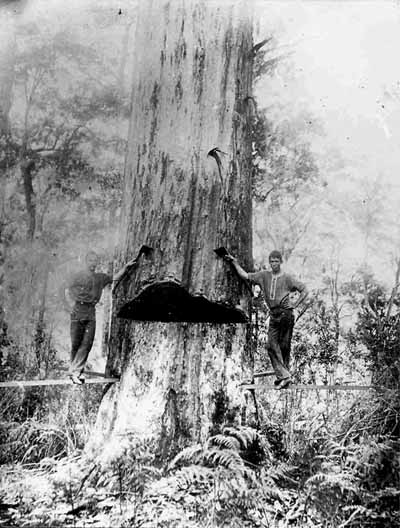
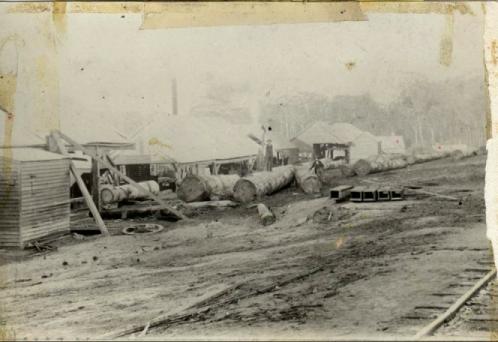
This hillside was part of a much larger logging holding that was taken up by the Millar brothers in 1895. The Millars opened their first mill in Denmark in 1893 and by 1905 all three of their mills were closed. By then the loggers had clear-felled all the ancient karri trees, and left a bare and ravaged landscape.

Timber cutters working on karri tree (Denmark Historical Society)

The demand for timber had been so high that the millers worked night shifts as well. Can you imagine working on a cold wet winters night with sharp steel blades, noisy machinery and massive timbers - by the light of kerosene lamps? 

level7mill.jpg - 27Kb
Old timber mill  (Denmark Historical Society)

It is quite different now. The steepest parts were abandoned and the bush re-covered the hillsides. Over time the gentler muddy red curves were coaxed into grassy green mounds by new settlers. Pretty but challenging. Today the patchwork of forest, pasture and vines is as varied as the people that now live there.

Last weekend we walked in this forest as summer gave way to autumn. As we arrived a deep indigo cloud dumped its load and a couple with a young child sheltered in their car. 

The rain had coloured up the mosses and lichens and frogs sang in their freshly moistened skins.


A fantail peeped close by as it flicked and fanned its tail


Old bark turned back


Shadows played


Strands of discarded summer trailed high overhead.


Cream karri trunks ready for the new season


The allocasuarina's deep corky bark flaunted the past, hid the present

  
Red winged wrens danced a duet  through the undergrowth


Tannin dark water rippled over black slippery rocks


In a pile of fallen bark at the base of a one hundred and eight year old tree, the child told us he was making a special spot for the forest fairies.


Did you have secret fairy spaces in your childhood? I did. I remember a special place at the top of our bush block in Parkerville. It was nestled in an ancient burnt out tree stump. The floor was mossy green sheltered by the jagged charcoal edges of the stump. In the hollowed middle green snail orchids grew as high as a fairy's waist. Outside in spring bright yellow cowslip orchids bloomed. In grade one we had a spot in the bush above the school. This place was encircled by grass trees and it too had orchids; from memory they were tiny pink fairy orchids.

I nearly missed the beauty of the reflections in the creek. It was only when I sat down on the rocks in the creek - slowed down to watch the wrens - that I saw them. Special places - it doesn't take much really - slowing down, seeing, imagining.


Monday, 1 October 2012

Dancing, drums and drills

Matthew Flinders surveyed the shores of Australia in the ship the Investigator, and was anchored in King George's Sound in December 1801 through to early January1802 before any British occupation of the area. He published a journal of his travels A Voyage to Terra Australis in two volumes which I found as an ebook from Gutenberg. It is a boon being able to access books like this so easily. I am actually investigating representations of the environment and vegetation, but occasionally other things jump out at me.

Anyway, I was fascinated by his account of  Wednesday 30 December 1801:

On the 30th, our wooding and watering of the ship were completed, the rigging was refitted, the sails repaired and bent, and the ship unmoored. Our friends the natives continued to visit us; and the old man with several others being at the tents this morning, I ordered the party of marines on shore to be exercised in their presence. 


The red coats and white crossed belts were greatly admired, having some resemblance to their own manner of ornamenting themselves; and the drum, but particularly the fife, excited their astonishment; but when they saw these beautiful red-and-white men, with their bright muskets, drawn up in a line, they absolutely screamed with delight; nor were their wild gestures and vociferation to be silenced but by commencing the exercise, to which they paid most earnest and silent attention. Several of them moved their hands involuntarily, according to the motions; and the old man placed himself at the end of the rank, with a short staff in his hand, which he shouldered presented, grounded as did the marines their muskets.

Drawing by an Aboriginal of the Kingston Tribe S.A.
from John Fairfax Conigrave, Adelaide, 1886.

Charles Darwin was in King George Sound in February 1836 and did not enjoy his time there at all; the summer heat, coarse vegetation and sandy ground, was probably too much for him. In his book The Voyage of the 'Beagle' he described a corroboree he witnessed while there. Here is an edited version:

A large tribe of natives, called the White Cockatoo men, happened to pay the settlement a visit while we were there. These men, as well as those of the tribe belonging to King George's Sound ... were persuaded to hold a "corrobery," or great dancing party. As soon as it grew dark, small fires were lighted, and the men commenced their toilet, which consisted in painting themselves white in spots and lines. As soon as all was ready, large fires were kept blazing, round which the women and children were collected as spectators; the Cockatoo and King George's men formed two distinct parties and generally danced in answer to each other. 

Engraving by J. Neill from Edward John Eyre, 1845

The dancing consisted in their running either sideways or in Indian file into an open space, and stamping the ground with great force as they marched together. Their heavy footsteps were accompanied by a kind of grunt, by beating their clubs and spears together ... In another dance, one man imitated the movements of a kangaroo grazing in the woods, whilst a second crawled up, and pretended to spear him. When both tribes mingled in the dance, the ground trembled with the heaviness of their steps, and the air resounded with their wild cries. Every one appeared in high spirits ... and so perfectly at their ease. After the dancing was over, the whole party formed a great circle on the ground, and the boiled rice and sugar was distributed, to the delight of all.

The visual parallels between the marine drills and corroborees were not lost on either Flinders or the Aboriginal people. Unfortunately the marine uniforms would soon come to represent negative attributes like  power, authority, retribution and an alien system of law.


Untitled tryptic by Gordon Syron, National Museum of Australia, Canberra

The last word on redcoats doing drill must go to Gordon Syron who plays with the way history has traditionally been visualised. He is a political artist who identifies as Aboriginal. He uses 'satire and raw imagery to send a message that Australian History has left out the Aboriginal people and their stories'. In his art he often 'turns around the picture' by doing things like portraying Aboriginal people in redcoats and black boots and reversing other historical Aboriginal and white roles, forcing the viewer to reconsider history.

Link to Syron's website here.  

All images sourced from the internet.

Wednesday, 12 September 2012

Bilyuin Pool

Bilyuin Pool was a surprise.

 Too far south for reliable summer rains, too far north for reliable winter rains and too far inland for there to be much of a river. The country was so dry I imagined a muddy puddle rather than a pool.

Mulga


The long miles heading south from Newman had been interspersed by pulling over for wide loads. It became a game to see just big - part of a R9800 excavator pulled by two trucks coupled together - and wide - a haul pack tray covering both sides of the highway - they could get. The R9800 is an 800 tonne backhoe excavator with a bucket size of 42 cubic metres!


Wide load heading north


We travelled through dry and barren country, then turned north onto the Ashburton Downs Meekatharra road. The black red gibber plains were bare apart from scattered silver grasses and short spinifex growing in company with gnarled and sparse grey mulgas. Mining trucks belted down the road raising billowing clouds of red dust.

Bilyuin Pool - believe it or not there are campers in this photo


It was along here that we found a series of pools on the headwaters of the Murchison River, probably 400km inland. Long and narrow, shaded by tall white gums and visited by numerous birds. Downstream from our campsite, a string of campers hugged the shore amid the trees. Some in transit like us, and others set up for a longer stay.

Bilyuin Pool river gum 


My bird list was very long with a variety of water birds, parrots, honeyeaters, birds of prey and colourful robins and whistlers. In the late afternoon light we were entertained by red capped and hooded robins hopping around our campsite, feeding. 

Red capped robin


Cormorants basked in the warm sunlight on the bank of a pool, while spoonbills basked higher up on the limbs of a dead tree.


Spoonbills


The morning was very cold, the dawn chorus was raucous and a beanie and gloves a necessity. Long before the sun's rays hit the grasses I watched female robins and whistlers bobbing along the ground then leaping up to peck cold insects off the silvery grasses. Crows stalked haughtily on the ground pretending to ignore the diamond doves and muddies sharing the same space. 

Bilyuin Pool at sunrise


The galahs and twenty-eight parrots squabbled over nesting hollows and from the distance came the piercing call of the whistling kites as they roved from tall tree to tall tree.

Pair of galahs


The surrounding vegetation was mainly mulgas, eremophilas and cassias. We found signs of earlier settlement here, remnant fences, posts, hand made bricks and a hearth. There were signs of even earlier inhabitants in what appeared to be stone chips of spearheads and the like. 

Cassia


It was a beautiful spot, all the more so because it was so unexpected. 

Hooded robin

Saturday, 8 September 2012

Seeing swans in black and white

I had to share these cartoons dating from the early days of British settlement of the Swan River Colony in Western Australia. They are funny and fascinating at the same time.

They show that the nature of capitalist enterprise was alive and well back then, along with a sense that those in positions of influence will try to get away with whatever they can - and that things don't always turn out as planned. Has anything changed? What I particularly 'love' about them is the depiction of the swans. The swans here are of course black - but to the British mind swans were white - and so black becomes white. Perhaps it is a window into the wrong-headedness of much of the early years of the colony. Seeing but not seeing, understanding but misunderstanding?? The swans don't look too happy either ...


Captain Dick Demi-Solde on a Wilde Goose Flight to the Swan River, 1829. by caricaturist  S. Stoutshanks, lithographer  Charles Ingrey, published in 1829.

The first image depicts the Duke of Wellington (Prime Minister of England) and is a criticism of the British Government over the establishment of the Swan River Colony.


Peel, Peel, Swan River Peel! Very Fine Peel! 1829. by caricaturist A Sharpshooter, published in 1829. 

The next two cartoons criticise the Right Honorable Robert Peel, who was Secretary of State (in England) and his cousin Thomas. These cartoons imply that Robert Peel influenced the decision to grant land to Thomas' syndicate of financiers who had tried to do a deal with the Government for a grant of prime land. However they failed to be allocated prime land as Peel's shipload of settlers arrived six weeks after the Government's stipulated deadline. They were allocated poorer land and eventually the whole scheme failed.


Cousin Thomas, or the Swan River Job [Plucking or Peeling], 1829 by caricaturist Robert Seymour, published in 1829.

All the images are from the National Gallery of Australia and are part of the Wordsworth Collection, purchased in 2010. Link to the NGA here.


Wednesday, 22 August 2012

Punda petroglyphs

Here are some more images from the Punda rock art site. As the crow flies it is not a long distance from the Wanna Munna site, but by car the route is very circuitous. I have adjusted the images into monochrome to increase the visibility of the petroglyphs.


It is a site that is fantastically rich in imagery and I am so glad we were able to revisit there. 


There were plenty of birds there too making the most of the spring water at the base of the rocky hillside. Here is a fraction of a flock of budgies wheeling in the sky.


Behind the hill, growing beside the water were some tall creamy trunked trees that I couldn't ignore. 


Tuesday, 21 August 2012

Wanna Munna

On the subject of artworks, here is a slip back to our time in the Pilbara. We called in to Wanna Munna which is about 75km out of Newman and relatively close to the main road. It is an Aboriginal rock art site straddling a water hole. Unfortunately there is a bit of graffiti at this site, probably because it is so close to the main road to Port Hedland. However I won't give electronic space to the graffitist efforts.

Wanna Munna boomerangs


Just to put the site in context here are two images looking upstream, where the majority of work is to be seen, and downstream where there is a beautiful jumble of rocks in the river bed.

Wanna Munna main pool upstream


Wanna Munna looking down stream


Some of the images picked on the rocks were very faint, and in places layered one on another. Presumably some of them are very ancient but again I can find little information about them. There were images of emus, kangaroos, spotted cats, figures - people?and boomerangs. It requires a high degree of skill to chip out such simple, elegant and true likenesses from hard and unforgiving granite boulders.

Wanna Munna rock art


Wanna Munna rock art emu and kangaroo


There were many birds here too - zebra finches, budgies, white naped honey eaters, mudlarks, corellas, willy wagtail amongst others. A large bird of prey flew in, a whistling kite, and off went all the other little birds.

Wanna Munna rock art figure


To finish here is an image of a tree that has defied the odds growing in a rocky crevice. They amaze me how they manage to do it.