Tuesday, 26 March 2013

Making the most of the mist


Last week we had misty humid weather, slightly warmish, with barely a glimpse of the sun. Cloud swirled in the valley, slipping between fog and mist and hazy air throughout the days. 
Chameleon weather.
 'Rain' simply condensed out of the moist air leaving a wet covering on everything.  


Glistening drops decorated leaves and branches, tiny autumn baubles.


 The birds have been happy.
 Their dawn chorus has been riotous; the wattle birds chortled in alto while twenty eight parrots pinged an out of sync descant in the still air.


I caught this twenty eight parrot having an air bath. 
Preening and ruffling its feathers in the heavy misty air.


Thursday, 7 March 2013

Walking in Harewood

When we first walked this trail eight years ago it was a one hundred year forest. 


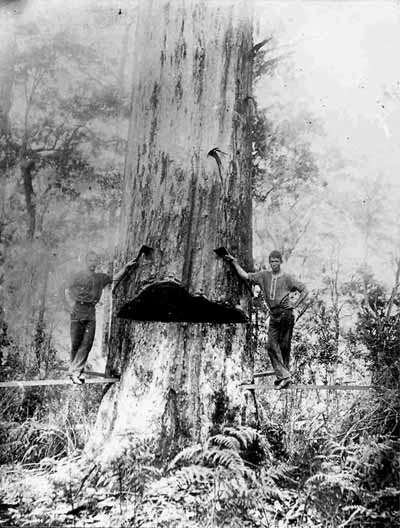
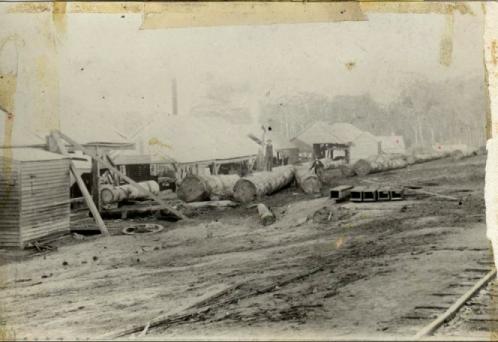
This hillside was part of a much larger logging holding that was taken up by the Millar brothers in 1895. The Millars opened their first mill in Denmark in 1893 and by 1905 all three of their mills were closed. By then the loggers had clear-felled all the ancient karri trees, and left a bare and ravaged landscape.

Timber cutters working on karri tree (Denmark Historical Society)

The demand for timber had been so high that the millers worked night shifts as well. Can you imagine working on a cold wet winters night with sharp steel blades, noisy machinery and massive timbers - by the light of kerosene lamps? 

level7mill.jpg - 27Kb
Old timber mill  (Denmark Historical Society)

It is quite different now. The steepest parts were abandoned and the bush re-covered the hillsides. Over time the gentler muddy red curves were coaxed into grassy green mounds by new settlers. Pretty but challenging. Today the patchwork of forest, pasture and vines is as varied as the people that now live there.

Last weekend we walked in this forest as summer gave way to autumn. As we arrived a deep indigo cloud dumped its load and a couple with a young child sheltered in their car. 

The rain had coloured up the mosses and lichens and frogs sang in their freshly moistened skins.


A fantail peeped close by as it flicked and fanned its tail


Old bark turned back


Shadows played


Strands of discarded summer trailed high overhead.


Cream karri trunks ready for the new season


The allocasuarina's deep corky bark flaunted the past, hid the present

  
Red winged wrens danced a duet  through the undergrowth


Tannin dark water rippled over black slippery rocks


In a pile of fallen bark at the base of a one hundred and eight year old tree, the child told us he was making a special spot for the forest fairies.


Did you have secret fairy spaces in your childhood? I did. I remember a special place at the top of our bush block in Parkerville. It was nestled in an ancient burnt out tree stump. The floor was mossy green sheltered by the jagged charcoal edges of the stump. In the hollowed middle green snail orchids grew as high as a fairy's waist. Outside in spring bright yellow cowslip orchids bloomed. In grade one we had a spot in the bush above the school. This place was encircled by grass trees and it too had orchids; from memory they were tiny pink fairy orchids.

I nearly missed the beauty of the reflections in the creek. It was only when I sat down on the rocks in the creek - slowed down to watch the wrens - that I saw them. Special places - it doesn't take much really - slowing down, seeing, imagining.


Monday, 4 March 2013

Table skinks and tomato frogs

King skinks are newcomers to our garden. They first showed themselves as a rustle and disappearing tail in my vege garden. And a tail that was distinctly not snake, which was a pleasant change. Next I came across a big one sheltering in my garden shed. Just today I came across this.


A king skink sunbaking on our garden table. The top slab is made from a huge lump of marri and it sports a large crack along the length of it. A perfect hiding space if you are a large skink. This king skink would be close to forty to forty five centimetres long.

Egernia kingii hiding in the table

These Egernia's are usually found not too far from the coast and love to shelter beneath rocks, in crevices like our table and burrows. They are omnivorous so I'm hoping they may have developed a taste for snails and slaters along with the usual insects and other small animals. I expect they will be munching on the plentiful tomatoes too.


On the subject of tomatoes - we have a plentiful supply of young frogs hanging out in the tomato bushes. I guess they like the humidity there. If they are not careful they may well become king skink dinner. Frog with a side serve of tomato. Delicious??


The frogs are Litoria moorei, or Western green tree frog. They have a distinctive call rather like a motorbike changing gears. Their other common name is the motor bike frog. When there is a moist change on the way they usually start calling about a day in advance. When rain is forecast and the frogs don't call we know the rain is probably going to bypass us.

Littoria moorei  


Time flies

I've been missing in action for quite a while. Life is like that sometimes. This month I hope to get back on track.


I have been preserving fruit. Damson plums - they make the most delicious plum jam - but they are fiddly, being small and cling stone. I bottled some too and they look great. The twenty eight parrots feast on the fruit high on the tree, while the chooks get the windfalls.


Brave New Works 20- Joey Williams
Joey Williams

I have been rehearsing two nights a week for Joey Williams' Songlines project. It is a cross cultural performance expressing the story of his family songline, performed in part to honour the memory of his father who died last year. His family totems are all the forms of fire - smoke, embers, fire sticks, sparking fire and flaming fire.


It was also an excuse to dye up some fabrics for our costumes - earthy and reminiscent of skins. Out came the dyepot and in went silks and cottons and karri bark, eucalypt leaves and rusty iron.


I have done some sewing as well, using fabric I had dyed and printed.


I have been helping to build the red tent, with many other woman, for Sarah Martin's Red Tent Project. It is a big geodesic dome built from bamboo struts and leather hubs, all bolted together and covered with a zipped together red vinyl covering. It is envisaged as a safe and nurturing space for woman.


I have been to writing workshops with Linda Bradbury as part of the Red Tent Project series of workshops. I managed to get to one of the Write in the Great Southern author talks.

Image by Bharat Sikka


We have been to Perth to catch up with family and attend the opening of the Pilbara Stories exhibition at Form Gallery way back in early February. The exhibition runs till 20th April. To get the best value from this exhibition the stories that were collected at the same time need to be read in conjunction with the images. The photographers are Martin Parr, Ketaki Sheth, Bharat Sikka, Annet van der Voort and John Elliott.


Image by John Elliott

And there have birds congregating on the inlet and pretty sunsets in amongst it all.

At the fisherman's jetty at Crusoe Beach


Pelicans and cormorants


Wednesday, 6 February 2013

Secretive rails


Every now and again we are lucky enough  to chance upon a buff-banded rail making an excursion into our garden. Recently I was outside early in the morning to pick a few ripe peaches for my breakfast. I love the sweet juicy flavour of gold fleshed peaches first thing in the morning. I eat a few while I pick them, and carry in the survivors with juice covered hands. Miske watches me attentively waiting for her share. I reluctantly give Miske a few morsels of the delectable flesh and any squishy fallen fruit. She loves to eat the summer fruits just as much as we humans do. One of the reasons we need to net our fruit is to keep Miske out, otherwise she would demolish any fruit within her reach.


Back to the rail. As I reached the fruit trees that morning, there in the shadows was a rail, quietly going about its business. Feeding in the grasses, pecking at the dandelion flowers, preening and stretching. I gently went back inside, grabbed my camera and came back out to photograph it. The rail seemed to be oblivious to my presence and carried on fossicking for quite some time before moving out of sight behind the swale. A day later I flushed it from beside the house feeding amongst the dichondra and roses. Off it flew down the paddock flashing its buff stripes.


Buff-banded rails are usually seen singly or sometimes in pairs. I have only seen individual rails here. They commonly are seen feeding early in the morning or late in the afternoon, hunting for anything from insects and small crustaceans and snails to seeds and fruits. And presumable dandelion flowers too. They live in dense damp vegetation found on the margins on wetlands both natural and man made. Their cup shaped nest is built on the ground, hidden in dense vegetation or reeds and grasses. Both parents incubate the young. The downy black chicks are able to leave the nest within twenty fours hours of hatching, being cared for by both parents in much the same way as chooks and ducks.


Red summer


This is the time of the year for the riot of colour brought to us by the red flowering gums, which grow naturally in limited coastal areas near here. Of course we grow them in our gardens, even though they can be a little touchy about conditions.


And the red winged wrens have returned after raising their young here in the garden some months ago. As soon as the babies were fledged and left the nest they disappeared into the bush. Just recently I have seen them flitting about the garden. The images below were taken on a particularly hot day. Nothing like a good splash to cool down and freshen up.


Tuesday, 29 January 2013

East meets West down South


Nikki Green beside her work Emunah (Faith)

Nikki Green's East West: A Pilgrimage is the latest solo exhibition on at the Butter Factory Studios in Denmark. It is the culmination of a journey that took Nikki to 'the crossroads of ancient civilisations in Turkey and Israel ... and to the cultural diversity in New York'. While overseas in 2012 Green delved into the mystical side of her Jewish heritage alongside an exploration of printmaking techniques in studios in Israel and New York. 


Mandala Series, black and white photographs


The geometry found in architecture, nature and eastern ornament is strongly evident in this current series of works by Green. Shown above are a series of photographs that have informed her work.

 The sublimely beautiful work Emunah (Faith) which is pictured at the top, has finely layered white on white multiple lino block prints. The effect is simple and mesmerising, capturing the essence of sacred geometries.

  Below is the work Etz Chaim (Tree of Life) which was an early work created by Green while in New York. The Etz Chaim is a symbol of energetic balance.

Etz Chaim (Tree of Life), lino block print on paper


 Below is Alul (The Emanation Series) a set of prints on canvas. The original prints were created by layering up to seven carved lino blocks of different sizes to create the varied but harmonic series.

Alul (The Emanation Series), glycee prints on canvas

In this next set, the work on the right is Ein Sof (Without End) and the two works on the right are Segulah (Treasure). They explore ideas of the subconscious, unity and inner treasure.

Eis Sof ( Without End) and Segulah (Treasure), lino prints on paper

This exhibition is on until the 11th February and is worth a visit if you are in the area. The works have a duality of simplicity and complexity which is quite intriguing. Green uses the interplay of texture, pattern and colour to great effect, at times restrained and at other times bold and complex. 

General view of the exhibition