Monday, 17 June 2013

Lace and parasols

I opened my neglected diary this weekend and discovered a forgotten morning. 

This tree has grown at least a hand span
 down over the top of this burn scar.

We walked along the trail and saw scarred trees healing from the top down and burnt stumps growing from the bottom up.  


We saw the scrabble marks of possums on marri trunks from many a night's journey to feast on nectar. 
I imagined the pink possum tongues cleaning sticky paws and sticky whiskers. 

Fire loving plants were missing from the long unburnt bush, their seeds waiting patiently for a spark.

As always I was fascinated by lacy patterns made by trees.


 This was an old, gnarled and stumpy branched marri. 
Bees flew in and out of it's trunk, humming in its heart.


The green filigree above was mirrored by the grey lichen doilies growing on the bark below. 

Underfoot the damp earth smelt sweet, strewn with creamy stamens from the fading blossoms.
Intense red parasols unfurled between summers drift.


Overhead, shadow like crows drawled an intermittent duet while 
 frogs plucked strings in a noisy chorus from a depression beside the stream.


Butter wouldn't melt in their mouths

This morning Miske taught the puppies 'digging' and  'under the decking'. I watched as she jumped off the decking with a few puppies in tow and deliberately dug a few scrapes in the soft sand, nuzzling the puppies. She walked away then came back and did exactly the same thing again. Two of the puppies pawed the sand, following her example. 'Digging!! ... we could have lots of fun here ...' Next she led them into a bigggg hole she had dug earlier - 'this is what you can do with digging'. They rolled down the slope and kicked up sand as they scampered back up the sides. Minutes later Miske went to the end of the decking where the access to underneath is, again with puppies in tow and stuck her nose underneath as if to say, 'take a look in there its fun'. She was definitely on a mission this morning.


Under the deck has always been a place of fascination for the dogs. A few years ago we heard the sounds of digging, scraping and whining coming from under our deck. It was our neighbours dog going through the nesting digging stage of pregnancy.  There must have been some primal memory of a 'good den' that she locked away sometime during her 'holidays' here. We were so surprised. We hadn't looked after her since she was much younger and to get here she had to squeeze under our fence to get in to our yard. No mean feat when you have a belly full of puppies.


Miske did the same with her first pregnancy too - under the deck and digging for her life. Getting these pregnant diggers out was no easy task either - all they wanted to do was dig a lovely, well hidden den. It was a fight between their nesting instinct and obeying a higher ranking member of their 'pack' calling them out. Second time around we just didn't give Miske the chance to dig when she was in the nesting phase - we kept her indoors or closely supervised while outside.

Under is the newest game

The first excitement of 'under the deck' turned to squeals of panic as the puppies worked out how to get back out. Miske poked her head down where they were, while we had to cajole them out, digging even bigger holes for those that had ventured all the way under. Tiny tails waggled excitedly as they figured it out - then the intrepid pups went straight back under to test out their new found game.


By the end of the day the hole was a favoured sleeping spot.

Monday, 27 May 2013

Languid

The afternoon warm was warm, the air still, lazy. The distant blue waters of the inlet mirrored the sky, occasional soft breezes skirmished the surface. A whipper snipper buzzed down the not so lazy kikuyu that sprang up in the late autumn warmth. A kookaburra claimed his territory.  High in a karri tree a ventriloquist magpie sang the songs of magpies, wattle birds and kookaburras. I wondered if the kookaburra I heard was really the ventriloquist. I don't know.

Then I spied a magpie hanging upside down, its claws clenched onto the tips of a karri branch, swinging wildly. It pecked at a cluster of leaves held together with webs - the hidey hole for some tasty morsels. Swinging. Leaves fluttered to the ground.  With the parcel secure in its beak the maggie arighted itself on a nearby branch to feast. Parcel clutched in the claws of one foot, the other clung to the branch. Peck, peck: it feasted then dropped the leftovers. All the while the ventriloquist sang.

Autumn days like that are just beautiful. Relax, soak up the sun. Watch the puppies gorge themselves on milk, then sleep and get fat. They've certainly got their priorities worked out. I sat in the sun and sketched blue wrens and fire tail finches as they flitted and fed around me.


This was the moon that night - a couple of nights ago. I've been trying to capture the moonrise as it hangs suspended in the last rays of the sunlight but I always seem to miss it. By the time I see the moon through the trees it is way up in the sky - just because of the lie of the land around here.


I remember a few years ago we were travelling up north near the Gascoyne River in the middle of winter. The rising full moon and setting sun both hung suspended above the horizon for what seemed like ages as the sky changed colour from gold and green to peach and pink then indigo that slowly arced across the sky. It was so beautiful.


Saturday, 18 May 2013

Eight

Once again we have tiny black and white bundles of warm furriness and squeals and mewling to fill our idle moments. Miske produced eight tiny puppies on Tuesday morning. She insisted I was up all night with her - going so far as to follow me into another room to drop the last pup.  We thought that seven was surely all there was to be. No. Eight.


So we are back into the routine of mewling, baby barks, and the silence of contented sleep, occasionally punctuated by loud cries of distress if a puppy finds itself too far away from its comfort zone.


It also means I've seen a few more sunrises than has been usual as I'm up early to give Miske her morning feed. She is ravenous.


I'd been promising myself I would tromp through the bush next door to get  a better view of the inlet in the morning light and finally I did, with Miske in tow. The sky had an extra reddish glow because the autumn burning off of the bush is in full swing. During the fine days there is always a smoky haze somewhere on the horizon - taking advantage of the cool and damp sweet spot between the too hot and dry of summer and the too wet of winter.


Wilson's Inlet - there is a town down there somewhere below the trees
 
Miske was a little sidetracked by all the delicious scents on the dewy bush trails. All I could see was the intermittent flash of her white tail as she snuffled off through the thick undergrowth. After taking my photos I called her back and reminded her about her puppies. Then she was off and racing back to her brood. Spoilsport.


Monday, 13 May 2013

Woolly banksia


This lovely Banksia baueri is flowering in our garden at the moment. The flower heads are large - a good twelve centimetres in diameter and very soft and woolly. Unlike most banksias they are pollinated by little furry marsupials like honey possums and pygmy possums. So far I haven't seen any mature seed pods on the old flowers so I guess we haven't hit the jackpot in attracting them to our garden yet, but I live in hope.

Banksia coccinea, plate 3 in
 Illustrationes Florae novae Hollandiae
Ferdinand Bauer

Banksia baueri was named by botanist Robert Brown after the brothers Ferdinand and Francis Bauer. These brothers were fantastic natural history illustrators. Franz was botanical artist attached to Kew Gardens in England from 1790 to 1840. Ferdinand was employed as botanical draughtsman under the direction of Robert Brown as chief botanist aboard the Investigator, captained by Matthew Flinders. The English  expedition of discovery left Portsmouth in 1801, circumnavigated Australia, and was forced to stop at Port Jackson where the Investigator was condemned as unseaworthy.


Johnsonia lupulia, plate 1 in
Illustrationes Florae novae Hollandiae
Ferdinand Bauer


Brown and Bauer finally returned to England in the repaired Investigator in 1805. In the intervening time Bauer explored the Sydney region and spent eight months on Norfolk Island. Over the four year period Ferdinand made over 2000 drawings, mainly Australian plants. After their return Ferdinand  Bauer spent years working on three hundred watercolours from his Australian sketches, most of which are held in London, and a series of hand coloured etchings for his Illustrationes Florae novae Hollandiae which was published in 1813.


Brunonia australis, plate 10 in
Illustrationes Florae novae Hollandiae
Ferdinand Bauer

The first two illustrations by Bauer are of plants that grow in the Albany region. The third illustration is of one of my favourite inland plants. It is a magnificent sky blue which always looks startling when seen against the rich ochre red soil in which it commonly grows.


Ferdinand Bauer images from the National Gallery of Australia.


Sunday, 12 May 2013

A flash of gold

I can't believe how time has slipped by - it's nearly a month since I last posted. We've been having plenty of rain and cloudy weather but today we had some lovely sunshine which enlivened the birds in the garden.

A special treat was hearing a male golden whistler calling insistently from the bush next door. I grabbed my camera and hopped through the fence. There he was, up high in the marri canopy, flying from branch to branch and whistling loudly - presumably trying to impress the female who was much closer to the ground.

Female golden whistler


The female was much happier to get close to me - but the male kept his distance - hence the less than wonderful photograph. But isn't he a wonderful colour - his voice is equally impressive.


Male golden whistler


Another fascinating find this weekend was the nest pictured below. The nest had been hidden under a dead banksia and was revealed after I burnt the bush to encourage the banksia cones to release their seeds. It was made of densely woven grasses and looked fairly recent. On looking around I found another older nest under a nearby shrub. It seems that it may be the nest of a banded rail, which is amazing as the site is close to the house and quite a distance from the creek line (dense and damp bush being their favoured habitat). 


So the buff banded rail I saw back in January was probably nesting. Fantastic. Apparently they have a clutch of six or so young that leave the nest soon after they have all hatched.  


Finally, a new holland honeyeater in the sunlight on one of their favourite shrubs at the moment, a beaufortia. The birds fly in and swing off the tall slender branches as they chase the nectar. Their necks are as wispy as the feathery red flowers. 


Wednesday, 17 April 2013

Beaufort Inlet

We arrived at Millers Point in the afternoon warmth, as small black coots swam low in the water and left a wake of tiny sparkling suns.

Coots feeding

Millers Point juts out into the Beaufort Inlet on the Pallinup River and the campsites are scattered among straight trunked eucalypts and twisty paperbarks.


From our spot we could see and hear the distant ocean which pounded on the bar to the south east and look around to the north west where the broad expanse of water disappeared behind hazy blue hills.


Looking inland

It is quite obviously a haven for fisher folk. The other campers took off early in the morning and returned in their dinghies late in the afternoon, leaving the point deserted apart from us and a couple from the eastern states.


The quiet thrum of generators that preserved their catch was the only human made sound to be heard during the day. Late in the afternoon the pelicans flew in waiting for the scraps from the returning fisher folk. The pelicans gave an occasional grunt; perhaps a 'hurry up and feed us' or a 'it's all mine not yours'. I don't know.


In amongst the rocks I found piles of silvery discs, the relics of successful fishing ventures.
The sandy beaches were covered in webbed footprints.


An old sign whose original intent has long since been lost


We walked to the lookout through a beautiful glade of eucalypts with trunks of ochres and greys.


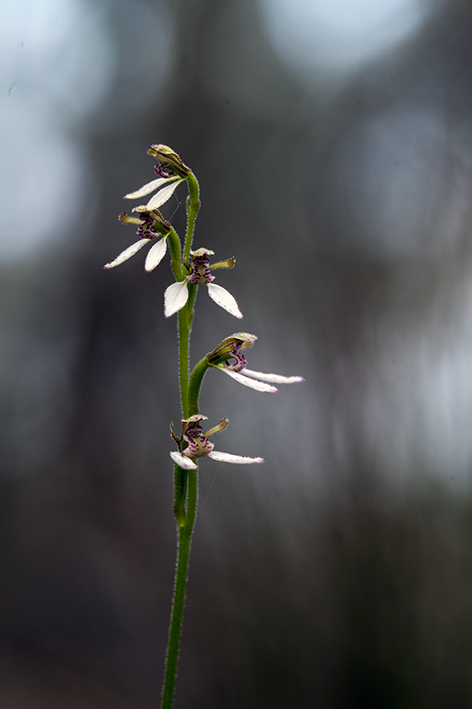
 In the thick mulch below grew autumn flowering bunny orchids.


And on the fallen branches grew these lovely lichens.


The view from the top past flowering Hakea laurina towards the bar and ocean.


According to South Coast Rivercare the Pallinup River rises in The Yilgarn Plateau south of Katanning with some salt lakes draining into the catchment in wet years. All the river is saline to some degree. The salinity has increased since clearing in the catchment region especially since the 1950's. Melaleuca cuticularis (saltwater paperbark) and Eucalyptus occidentalis (yate), are found growing here as both do well in saline conditions.