Thursday, 30 January 2014

String and contemporary textiles

I've just come back from a quick trip to Perth to catch up with friends that I haven't seen for ages and I managed to fit in a few exhibitions as well. I was impressed by String Theory at PICA (Perth Institute of Contemporary Arts). I managed to catch it on the last day. It is a travelling exhibition from the Museum of Contemporary Arts Australia and features the work of  more than thirty Australian Aboriginal artists and artist groups. The majority of the works have some relationship to textiles or the tactility of craft working. This ranged from printmaking to fibre sculptures, photography to doll making, to more contemporary installations and video.


Some of my favourite works were the life size sculptures by  Niningka Lewi, Minya Punu Kungkarangkalpa (The Seven Sisters),2013. They were made from grasses and other fibres and were marvelously animate and colouful. I thought they were great and it looks like the kids in the image below thought so too.

Photo: This show is pretty wild! Come check out the enormous STRING THEORY exhibition- opening Friday 15 November, 6pm! 

https://www.facebook.com/events/220549558106565/

Photo: gorgeous kiddies checking out the seven sisters by the Tjanpi Desert Weavers at PICA today

There was a collection of strings made from traditional materials bark fibre and feathers, strong and delicate. The work below is by Frances Djulibing, Yukuwa (Feather string yam vine), 2013 made from banyan tree bark, cockatoo feathers and beeswax. This was a large suspended installation was wafted delicately as you moved around it.

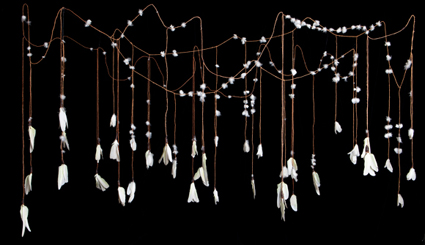

Frances Djulibing, Yukuwa (Feather string yam vine), 2013. Banyan tree bark, cockatoo feathers, beeswax. Museum of Contemporary Art, purchased 2013. Image courtesy and © the artist


The painting below was traces the twining patterns found in dilly bags. It is by Regina Wilson, Wagardi (Dilly Bag), 2010.


The work below is by Dale Harding, Bright Eyed Little Dormitory Girls, 2013, one of a series in the installation.


In the video you get a glimpse of a series of lace collars with leather which really grabbed me in the heart. I'm afraid it reminded me of Roebourne Prison which I visited a few years ago and found it a very traumatic experience. I'm sure the work referenced young Aboriginal girls being forced to work as house maids but for me it had overtones of the terrible neck chains used on Aboriginal prisoners .


There was a series of colourful artline works by Jimmy Pike all part of the UWA Berndt Museum collection which I thoroughly enjoyed . 'Headband', illustrated above gives an idea of the richness of his work. Coincidentally I am reading You Call it Desert - We Used to Live There by Pat Lowe with Jimmy Pike. This book describes life in the Great Sandy Desert as lived by small family bands before the arrival of  kartiya (white people) and the changes to the land and cultural practices since then. It covers things like waterholes,  tools, medicine, children's games, birth and death, and the Walmajarri language. The easy to read text is complemented by many photographs and Pike's drawings and paintings.

It was a great show and I thoroughly enjoyed it - the only downside was that the catalogues had sold out - good for PICA bad luck or me. Coincidentally I subsequently met the photographer responsible for the images for the catalogue while minding the Butter Factory Gallery down here. She said the artists had some amazing stories to tell, particularly the stories associated with the dolls. (The video gives a glimpse of the collection. I tried to embed the video but couldn't make it work so you need to follow the link.)  

I wrote this on the tenth but for some reason didn't publish it, so here it is now.


All images from the PICA website and PICA Facebook or the UWA Berndt Museum website..

Thursday, 5 December 2013

Blue mobsters

I was in the garden the day the blue wren fledglings flew the nest. 

I had watched as they built the nest in a prickly acacia right beside the path to the vege patch. A wren in the chook yard collecting feathers is a bit of a give away. Things went quiet for a while as the parents sat on the eggs, then once the babies hatched life got busy for them. That was when the rest of the mob joined in. There was a constant stream of them, catching food and delivering to the hungry mouths in the nest.   


That morning, I was seated on the deck, savouring the early sunshine and the last mouthful of my breakfast, cashews and craisins. Two tiny grey shapes flashed across the corner of my eye. They zoomed onto the verandah, rapidly followed by Blake who dived after them. One veered up and away, the other was hidden behind Blake's large furry body. I yelled and jumped up in an instant my heart in my mouth. Horror at he thought of the tiny baby disappearing down his gullet.


Blake pulled back instantly and I saw a little pile of grey feathers on the ground ... not moving. This was not looking good. I picked up the body, it was alive, unharmed, but had a tangle of spider webs ensnaring a wing and a foot. No wonder it bombed onto the ground. You should have seen the blue wren mob suddenly appear when I picked the baby up. I was surrounded by four grey females and three bright blue males all scolding me. Very unhappy mobsters. 


The fledgling felt so fragile as I carefully pulled the sticky web away. It was a delicate operation, the bird was tiny, just a few grams and the thinnest legs you can imagine. Finally free of web, I let it go, wondering how it could possibly fly at all, it had such a short tail and the bird was sooo tiny. But it was up and away onto the beams of the shadehouse. Soon the family were there beside it and normal feeding resumed.


This is the baby with a fuzzy parent in the foreground.


Monday, 18 November 2013

At long last


 There is a pair of Pacific Black Ducks that have lived here for some years.
 I have never seen them with young until now. 
Look what appeared on our dam this week.


They have manged to raise seven ducklings that are now half grown. 


 Here they are after their swim heading off in single file. 
It is fantastic to see. 

Quink quink, kik kik

For over a week I stalked Western Rosellas. They could be seen from inside the house on the Guitenotia bush, feasting on the seed pods. The soft silky grey foliage was bejewelled by flashes of red, yellow, blue and green. As soon as I walked outside they would be off flying down the paddock, not returning till I had gone back inside. I could hear their high pitched 'quink quink ..quink quink' but not see them. Despite their bright colouring they are difficult to see if they want to stay hidden. Western Rosellas tend to feed quietly in pairs or small groups. Around here that is often on the ground in the pasture or in fruit trees if they are not netted.


In the end, when there were few seeds left on the bushes, I persevered. I stayed outside and stalked them. I'd see a bird, it would see me, then take off. This loop played out over and over. Finally the above bird returned and landed on some kangaroo paws. It looked at me - shocked - when it realised I was only metres away. Something changed and it lost its caution. The Rosella flew over to the Guitenotia and ate happily while it watched me as I photographed it.


In this last week the Sacred Kingfishers have returned for their summer breeding season. The pair here called to each other 'kik kik kik kik'; one near our house the other down by the creek. This fellow hunted for food, swooped down to the ground and back up to a high vantage point before it flew down the hill towards it's mate.


Low tide at Lights


Thursday, 7 November 2013

Beach surprise

After an absence of several weeks I finally got to the beach today. Miske had been in season which meant we had been confined to walking in 'safe' locations: down to the dam and back or into the bush next door. Definitely not to the dog beach. Blake, the puppy we kept, had been taken to the beach a few times by friends when they took their dogs down to the beach, so he had at least had a bit of fun. Blake is now as big as his mum, much to her chagrin. She wants to be boss and he wants to be annoying. Now Blake just woofs at her to let her know he isn't happy about something. I have seen her give up a bone to him after one woof. Not a good precedent if she wants to stay boss.


The tide was way out exposing thin green slivers of water weed laying flat on the limestone rocks, the weeds occasionally raised up as an incoming wave lifted and swirled around and over then raced towards my feet tracing the moving edges of the water. Sooty oyster catchers with their distinctive red beaks and eyes took advantage of the low tide, and picked and probed a smorgasbord fresh from the rocks.


While I was photographing the ocean an immature Pacific Gull lazily drifted into my picture frame. 


It floated along the jagged limestone edge just in front of us before it flapped up and off further down the beach before commencing the lazy drift again. 


The last thing I expected to see down the beach this morning was a small flock of white tailed black cockatoos. They were feeding on the seeds of the wild geranium growing only metres from the sandy beach. The birds were half hidden on the ground, becoming visible as they flapped up and drifted a few metres along with the breeze, then dropped down to feed once more.


Look carefully there are five cockies in the image above.


Here they are much easier to pick out. They are probably Baudin's Cockatoo as they breed in karri country as opposed to Carnaby's Cockatoo which breed mainly in the wheatbelt. Their different bill shapes are rather difficult to determine from a distance. Baudin's has a long narrow upper bill and Carnaby's has a short thick upper bill. Their calls are different too, but these fellows were too busy eating to be calling.


Saturday, 12 October 2013

Catching up and sitting down

It is over three weeks since we came back from our holidays. In the intervening time it has been catch up on the home front - unpacking and cleaning up and taming the rampant garden - as well as indulging in the arts. My first week back was spent finalising my works for, then helping to set up the Be Seated exhibition at the Butter Factory Studios and Gallery. Finally I feel I have time to sit down and type.


The Be Seated exhibition is part of the Bendigo Bank Southern Art and Craft Trail which comes to an end with the end of the school holidays. We had a marvelous opening, with entertainment by Sound Bites choir singing to a seated theme. A colourful Gertrude Well-ease, sported a stunning chairy hat and dispensed a lively commentary on the artworks, to our many visitors.


Bruce's carved cardboard chair and raku cylinders


Gabriele's granite stairs


My stitched pit fired ceramics


Close up on Helmie's chair and more of her work in the background


Work by Nikki, Helmie and myself


Work by Nikki


Peppermint spirits by Robyn and painting by Helmie


Mixed media works on wall by Barb


Works by Robyn


Works by Alison


For more photos follow this link to Butter Factory Studios and Gallery.